
The Question Nobody Answers Directly. Until Now.
Every couple hears IUI and IVF in the same breath. Most leave the consultation not fully understanding the difference or which one is right for their situation.
This blog gives you that answer. Directly.
IVF vs IUI: What They Each Actually Do
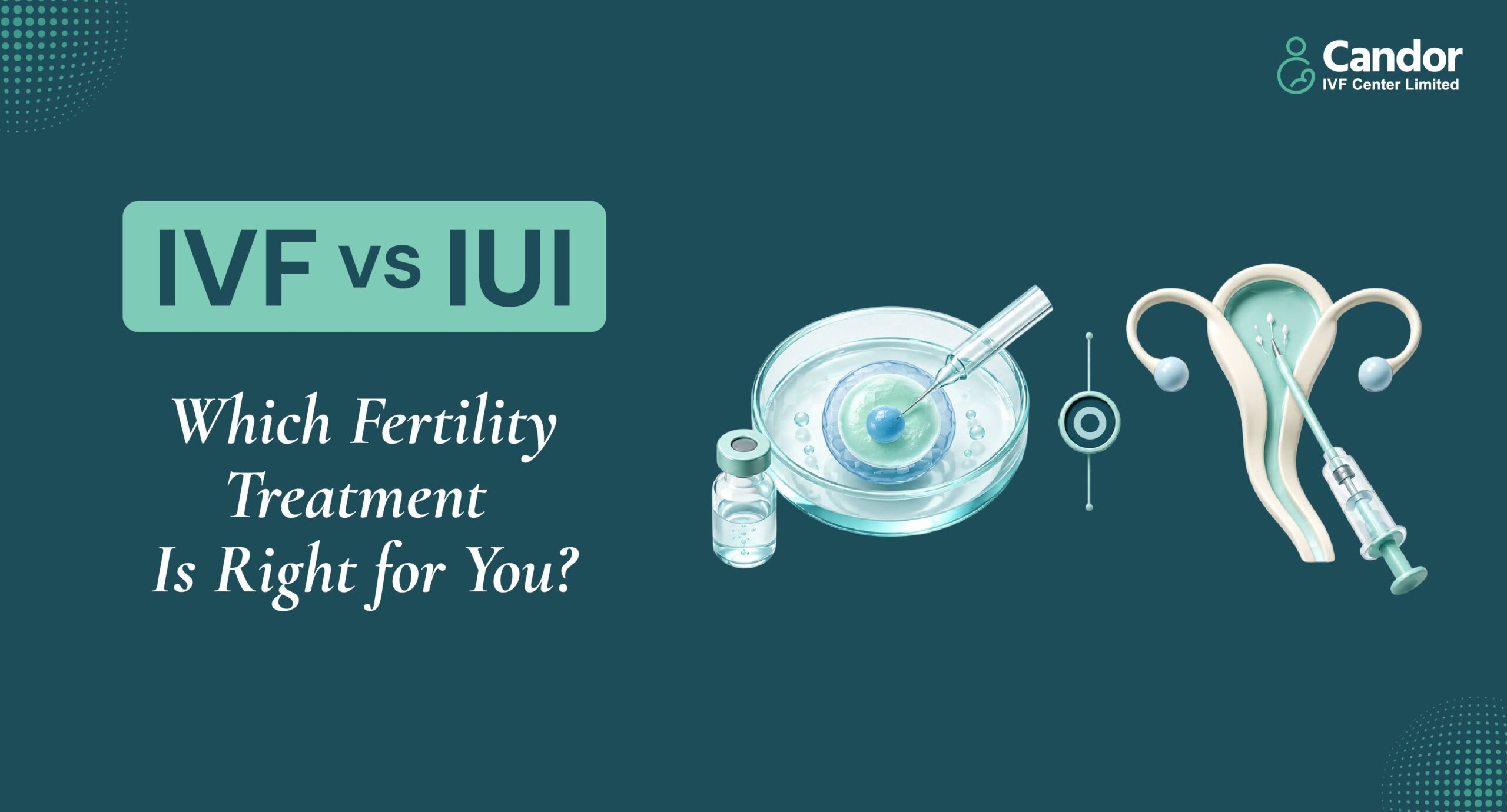
IUI (Intrauterine Insemination) Washed and concentrated sperm is placed directly into the uterus at the time of ovulation. That is it. Fertilization still happens inside the body, naturally, in the fallopian tube. IUI reduces the distance sperm has to travel but does not control or guarantee fertilization.
IVF (In Vitro Fertilization) Eggs are retrieved from the ovaries, fertilized with sperm in a lab, and the resulting embryo is transferred into the uterus. Fertilization happens outside the body under controlled conditions. The embryologist can assess egg quality, embryo grade, and select the best candidate for transfer.
The core difference: IUI assists the journey. IVF controls the outcome.
IUI vs IVF Success Rate: The Numbers Side by Side
| IUI | IVF | |
| Per cycle success rate | 10 to 20% | 40 to 60% (under 35) |
| Women over 38 | 5 to 10% | 20 to 30% |
| Cumulative (3 to 6 cycles) | 40 to 50% | 70 to 80% |
| Requires open tubes | Yes | No |
| Controls fertilization | No | Yes |
IVF has significantly higher per-cycle success rates. But IUI costs a fraction of IVF and is far less invasive. The right choice is not automatically the one with the higher success rate. It is the one that fits your diagnosis, your age, and your timeline.
IUI Cost vs IVF Cost India: The Real Comparison
| IUI | IVF | |
| Cost per cycle India | ₹10,000 to ₹30,000 | ₹1,20,000 to ₹3,00,000 |
| Medications | ₹3,000 to ₹8,000 | ₹30,000 to ₹70,000 |
| Monitoring scans | ₹2,000 to ₹5,000 | ₹5,000 to ₹20,000 |
| Anaesthesia needed | No | Yes (egg retrieval) |
Three failed IUI cycles at ₹25,000 each is ₹75,000. One IVF cycle starts at ₹1.5 lakh. The gap is real, but so is the time cost of multiple failed IUI attempts when IVF was the right answer from the start.
When Doctors Recommend IUI: The Right Scenarios
IUI makes sense when:
- Unexplained infertility in a woman under 35 with normal tubes and good ovarian reserve
- Mild male factor infertility: low count or motility, but not severely compromised
- Cervical factor issues where sperm struggle to pass through the cervix naturally
- Single women or same-sex couples using donor sperm
- PCOS with confirmed ovulation after induction, with no other complicating factors
IUI requires at least one open fallopian tube. If both tubes are blocked, IUI is not an option at all.
When to Choose IVF Over IUI: Clear Criteria
Move directly to IVF when:
- Both fallopian tubes are blocked or damaged
- Severe male factor infertility: very low count, poor morphology, or zero sperm in ejaculate
- Age 38 or above: per-cycle IUI success drops below 10% after 38; the time cost of multiple IUI attempts is significant
- Endometriosis stage 3 or 4: moderate to severe endometriosis compromises the fallopian tube environment
- 3 to 6 failed IUI cycles with no clear explanation for failure
- Previous IVF success or frozen embryos available
When IUI fails three times, most fertility specialists recommend moving to IVF rather than continuing. Repeating the same protocol without changing the approach rarely changes the outcome.
ICSI: The Middle Ground That Changes Everything
ICSI (Intracytoplasmic Sperm Injection) is not a separate treatment path. It is an addition to IVF that becomes essential in specific cases.
In standard IVF, eggs and sperm are placed together in a dish to fertilize naturally. In ICSI, a single healthy sperm is injected directly into each mature egg.
ICSI is recommended when:
- Sperm count is very low
- Sperm morphology is severely abnormal
- Previous IVF cycles showed poor fertilization
- Sperm is surgically retrieved (TESA or PESA)
ICSI adds approximately ₹15,000 to ₹40,000 to the IVF cost. When male factor is involved, it is not optional. It is the difference between fertilization happening or not.
Should You Try IUI First or Go Straight to IVF?
Run through this before your consultation:
Start with IUI if: You are under 35, both tubes are open, sperm parameters are mildly affected, and you have time for 3 to 4 cycles.
Go directly to IVF if: You are 38 or above, tubes are blocked, male factor is severe, or you have already tried IUI without success.
Add ICSI to IVF if: Male factor infertility is confirmed or previous fertilization was poor.
Age is the deciding variable most couples underestimate. A 37-year-old woman spending 6 months on IUI cycles that do not work has fewer eggs at 38 when she starts IVF. Time spent on the wrong treatment is not neutral. It has a biological cost.
FAQs: IVF vs IUI
- Is IUI or IVF better for unexplained infertility?
– IUI is a reasonable first step for unexplained infertility in women under 35. After 3 to 4 failed IUI cycles, IVF is the recommended next step. - How many IUI cycles should I try before IVF?
– Most specialists recommend 3 to 6 cycles. If you are over 35 or have a clear diagnosis pointing to IVF, moving earlier is advisable. - Can I do IUI with blocked tubes?
– No. IUI requires at least one open fallopian tube for the sperm to reach the egg. Blocked tubes require IVF. - Is ICSI better than IVF?
– ICSI is a technique used within IVF, not instead of it. It is recommended when sperm parameters are significantly compromised. - What is the IUI success rate after 40 in India?
– Below 5 to 10% per cycle. IVF is strongly recommended for women over 38 rather than continuing IUI.
What Candor IVF Recommends
At Candor IVF, this decision is never made on gut feel. It is made after reviewing your AMH, tube patency, sperm DNA fragmentation, and age together.
Some couples need IUI. Some need IVF from day one. Some have spent two years on IUI when IVF was always their answer.
The consultation at Candor IVF tells you which category you are in. Free. Before you spend a rupee on treatment.
Book your consultation at Candor IVF today.

Dr. Jaydev Dhameliya is an IVF consultant and reproductive medicine specialist with over 17 years of clinical experience helping couples on their journey to parenthood. He holds an MBBS and DGO, and is a Fellow in Minimal Access Surgery (FMAS), a trained laparoscopic surgeon. As Founder and Director of Candor IVF, he specialises in IVF, infertility treatment, laparoscopic gynaecological surgery, and high-risk pregnancy management. Every article he authors or reviews reflects current medical evidence and his hands-on patient experience.