

“Everything Looks Fine” Is Not the Same as “Nothing Is Wrong.”
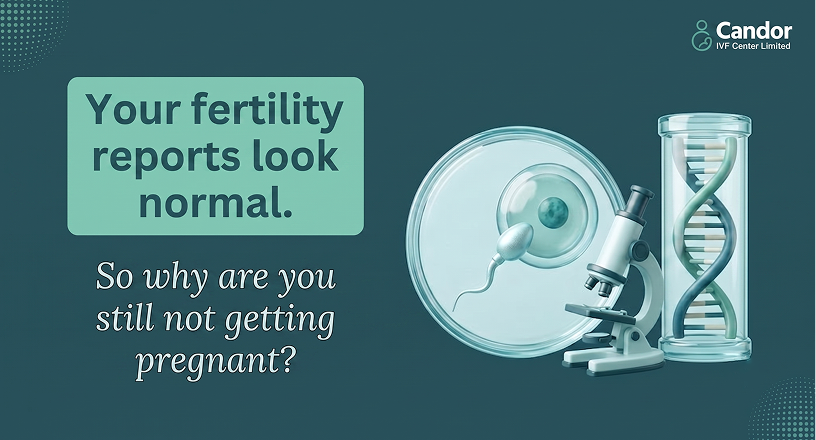
You did the hormone panel. The ultrasound. The semen analysis. Every report came back within normal range. And yet, month after month, nothing.
This is one of the most disorienting places a couple can be in. There is no diagnosis to research, no clear villain to treat. Just a stack of normal reports and a question nobody at the lab can answer.
This has a name: unexplained infertility. And normal reports do not mean nothing is happening. They mean the standard tests were not built to catch it.
Table of Contents
ToggleWhat Does "Unexplained Infertility" Actually Mean?
Unexplained infertility is diagnosed when a couple has been trying to conceive for 12 months (or 6 months if the woman is above 35), and every standard test comes back normal: regular ovulation, open fallopian tubes, a normal uterine cavity, and a healthy semen analysis.
It is not a rare outcome. Depending on how thorough the initial workup is, unexplained infertility accounts for anywhere between 15% and 30% of all infertility cases. That is a significant share of couples being told their tests are clear while still not conceiving.
The diagnosis is not the end of the investigation. It is a signal to look deeper.
What Standard Fertility Tests Do Not Check
Basic fertility testing is designed to rule out the obvious. It was never designed to catch everything.

Egg quality beyond ovarian reserve
AMH and antral follicle count measure how many eggs remain, not how genetically or chromosomally sound those eggs actually are.

Endometrial receptivity
A uterus can look structurally normal on ultrasound while the lining still fails to accept an embryo at the right window.

Chronic endometritis
A low-grade, often symptomless uterine infection that standard scans routinely miss, but that can quietly interfere with implantation. Studies have linked it to unexplained infertility, with pregnancy outcomes improving after targeted antibiotic treatment.

Sperm DNA fragmentation
A standard semen analysis checks count, motility, and shape. It does not check whether the DNA inside that sperm is intact, which can affect fertilization and early embryo development even when every other parameter looks normal.

Mild or early-stage endometriosis:
Often invisible on ultrasound and only confirmed through laparoscopy, yet capable of affecting egg quality and implantation.

When Should You Move Beyond Basic Testing?
If you have completed a full standard workup, both partners, and it came back clear, that is the point to ask for the next layer of testing, not to simply keep trying with no new information.
Advanced Diagnostics Cost in India
| Test | Cost Range |
|---|---|
| Sperm DNA fragmentation test | ₹4,000 to ₹8,000 |
| Hysteroscopy with endometrial biopsy | ₹15,000 to ₹35,000 |
| Diagnostic laparoscopy | ₹30,000 to ₹60,000 |
| Endometrial receptivity assessment | ₹20,000 to ₹40,000 |
Not every couple needs every test. A fertility specialist should recommend based on your specific history, not run every panel by default.
Unexplained Infertility Care at Candor IVF
At Candor IVF Center, when a couple’s reports look normal but conception still is not happening, our specialists do not stop at “unexplained.” We dig into ovulation timing, uterine and tubal health, and male fertility factors with more depth than a standard first workup, and recommend advanced testing only where your specific history points to it.
If the cause remains elusive after deeper testing, treatment does not wait indefinitely. Depending on age and how long you have been trying, our doctors typically guide couples through 3 to 4 cycles of ovulation stimulation with IUI, moving to IVF if that does not result in pregnancy. Every step comes with a written cost estimate and No Cost EMI, across our centers in Surat and the rest of Gujarat.
FAQ
Does Candor IVF treat unexplained infertility?
Yes. Our specialists offer advanced diagnostics beyond the standard workup, along with a structured treatment pathway from ovulation stimulation to IVF.
What tests does Candor IVF recommend if my reports are already normal?
Depending on your history, this may include sperm DNA fragmentation testing, hysteroscopy, or a receptivity assessment. Not every couple needs every test.
How long should I try before asking for advanced testing at Candor IVF?
If you are under 35 and have tried for 12 months, or over 35 for 6 months, with normal standard reports, it is time for a deeper evaluation.
Will I need IVF if I have unexplained infertility?
Not necessarily. Many couples conceive with ovulation stimulation and IUI first. IVF is recommended if those cycles do not succeed.
Is advanced testing covered under EMI at Candor IVF?
Yes. All diagnostics and treatments come with a written cost estimate and No Cost EMI options.
Can chronic endometritis really cause unexplained infertility?
Yes, in some cases. It is often symptomless and missed on routine scans, but detectable through hysteroscopy and treatable with targeted antibiotics.
Normal Reports Are a Starting Point, Not a Dead End.
“Unexplained” does not mean untreatable. It means the standard tests reached their limit, not that your body has none left to explain. At Candor IVF Center, the next step is asking better questions, not repeating the same ones.
Book a fertility evaluation at Candor IVF Center today.