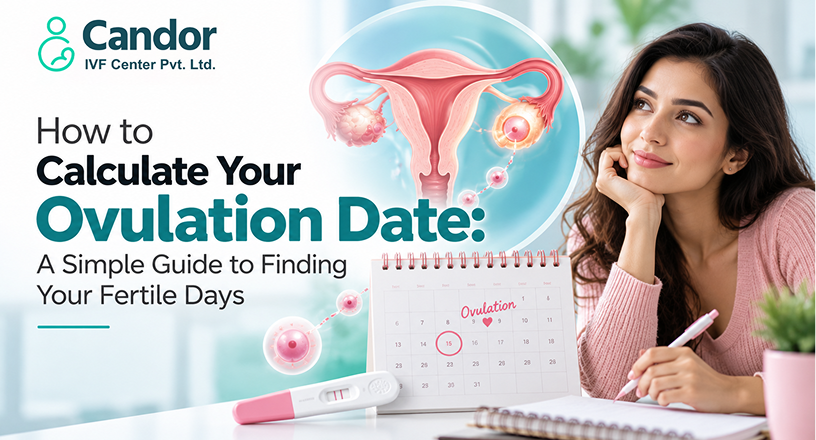

When you are hoping to conceive, timing can feel like a puzzle with too many moving pieces. A basic calculation narrows it down, and all it needs is a calendar. This guide shows how to estimate your ovulation date, turn it into fertile days and recognise where the method stops being reliable.
Table of Contents
ToggleStart by Measuring Your Cycle Length
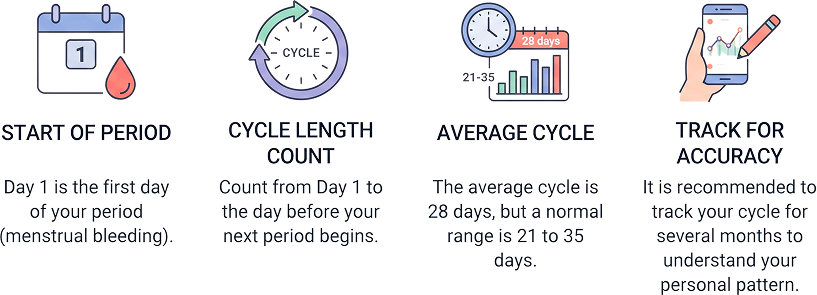
Count the first day of your period as day 1. Your cycle length is the number of days until the day before your next period. The average is about 28 days, and a range of 21 to 35 days is commonly seen in adults, though regularity and individual circumstances matter more than any single number. Track it for several months, since one cycle can mislead.
The Basic Formula
Ovulation usually happens about 14 days before your next period begins. Subtract 14 from your cycle length, and the result is your estimated ovulation day.
26-day cycle:
ovulation around day 12.
28-day cycle:
ovulation around day 14.
30-day cycle:
ovulation around day 16.
35-day cycle:
ovulation around day 21.
So ovulation on day 14 holds true only for a 28-day cycle.
Turning the Date Into Fertile Days
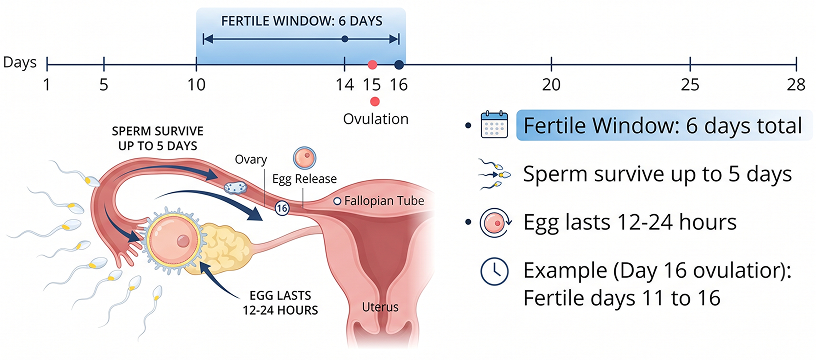
Pregnancy is possible during a window of about six days: the five days before ovulation and the day of ovulation. Sperm can survive for up to five days, while the egg lasts only 12 to 24 hours after release. If your estimated ovulation day is day 16, your fertile window runs from about day 11 to day 16. Intercourse every one to two days in this window gives the best chance.
If Your Cycle Length Changes From Month to Month
Few women have identical cycles every month. A widely used method accounts for this: record your last six cycles, subtract 18 from the shortest to find your earliest likely fertile day, and subtract 11 from the longest to find your last. If your cycles ranged from 27 to 31 days, this gives roughly day 9 to day 20. Treat that as a rough estimate, not a confirmed fertile window, as it suits fairly regular cycles best.
Ways to Fine-Tune Your Estimate
A calendar predicts. These signs show what your body is doing.
Ovulation predictor kits
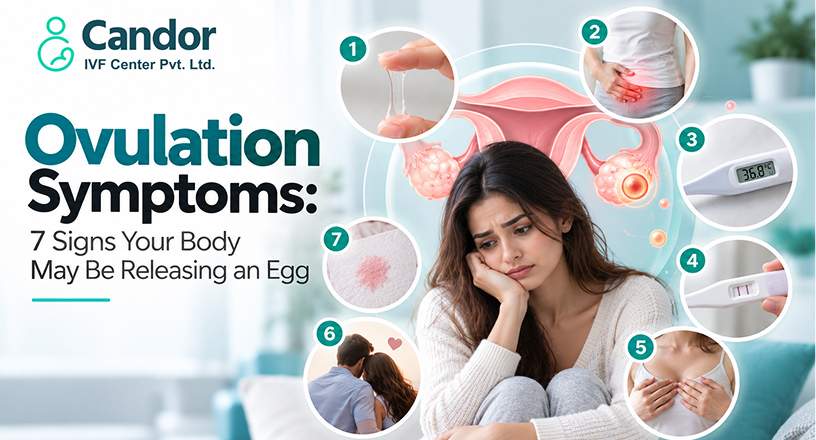
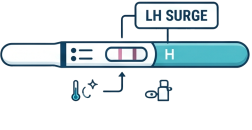
They detect the LH surge, which usually comes about 24 to 36 hours before ovulation. A positive result suggests ovulation is near, but it does not guarantee that an egg will be released.

Cervical mucus
Clear, stretchy mucus resembling raw egg white appears in the days before ovulation and marks your most fertile time.
Basal body temperature
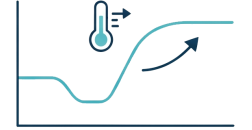
Your temperature rises by roughly 0.3 to 0.5 degrees Celsius after ovulation. This confirms ovulation afterwards and cannot predict it, but several months of charts reveal your pattern.

When a Calculation Is Not Enough
Calendar methods assume predictable cycles and become unreliable when your cycles fall well outside the usual 21 to 35-day range or vary widely, and after stopping hormonal birth control, after childbirth or while breastfeeding. Conditions such as PCOS can also shift or skip ovulation. Here the formula gives only an estimate, so tracking your signs and seeking medical guidance gives a clearer picture. Irregular timing is a common, often treatable reason for delay and says nothing about your effort.
How Ovulation Is Pinpointed at Candor IVF Center
When calculations and home tests leave you uncertain, a doctor-led evaluation can replace estimates with measurements. At Candor IVF Center, it begins with your cycle history and any earlier pregnancies. Your doctor then selects tests according to your cycle and clinical needs. Some women benefit from a follicular study, where ultrasound scans follow the growing follicle across the cycle. Others may need hormone blood tests, such as LH or progesterone, to confirm ovulation. Not everyone needs every test. Your doctor then explains what the findings mean for your fertile days, and whether timed intercourse, medication or continued home tracking suits you.
FAQ
Can I calculate ovulation if my periods are irregular?
Only roughly. The formula needs predictable cycles, so use ovulation kits and consult a doctor if yours vary widely.
Are online ovulation calculators accurate?
They use the same arithmetic, so they suit regular cycles. A predictor kit can narrow the timing.
Does a positive ovulation kit mean I have ovulated?
Not necessarily. It shows an LH surge, which usually precedes ovulation but does not guarantee it.
Can stress change my ovulation date?
Yes. Stress, illness and travel can delay ovulation, shifting the calculated date.
Can I get pregnant after ovulation has passed?
The egg survives only 12 to 24 hours, so the chance falls quickly once ovulation is over.
When should I see a fertility specialist?
After 12 months of trying if you are under 35, after 6 months if you are 35 or older, or sooner if your periods are irregular or absent.
Your Next Step
Your ovulation date is an estimate, but a useful one. A few months of tracking turns a vague guess into a pattern you can read, which also helps any doctor you consult. If it stays unclear, you do not have to work it out alone. A conversation with a fertility specialist, such as the doctors at Candor IVF Center, can show where your cycle stands.

Dr. Jaydev Dhameliya is an IVF consultant and reproductive medicine specialist with over 17 years of clinical experience helping couples on their journey to parenthood. He holds an MBBS and DGO, and is a Fellow in Minimal Access Surgery (FMAS), a trained laparoscopic surgeon. As Founder and Director of Candor IVF, he specialises in IVF, infertility treatment, laparoscopic gynaecological surgery, and high-risk pregnancy management. Every article he authors or reviews reflects current medical evidence and his hands-on patient experience.