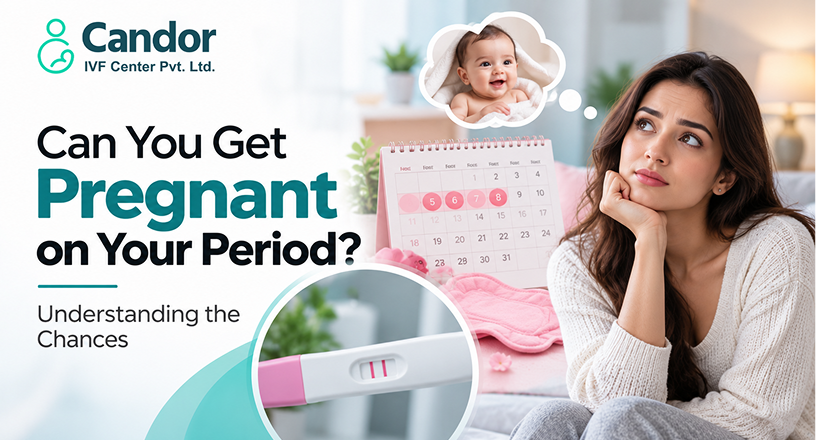


It is one of the most common questions women ask, whether they are hoping for a baby or hoping to avoid one. Conflicting advice makes it harder to know what to believe. The honest answer is that pregnancy during your period is unlikely, but it is possible. Understanding why helps you plan with more confidence, whichever direction you are planning in.
Table of Contents
ToggleWhy Pregnancy Is Unlikely During Your Period
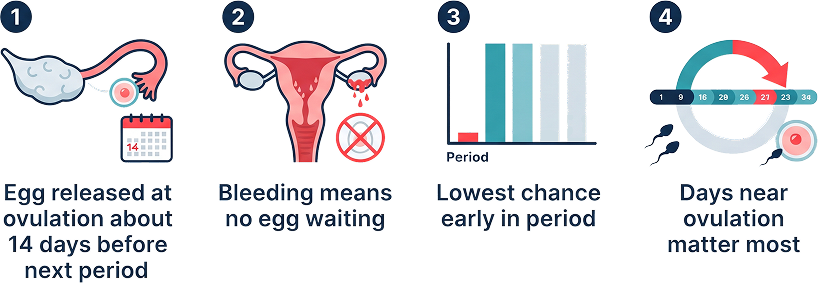
Pregnancy needs an egg to meet sperm, and the egg is released at ovulation, which usually falls about 14 days before your next period. In the first days of bleeding, ovulation is still well ahead, so there is typically no egg waiting. That is why the chance is lowest early in your period, and why the days leading up to ovulation matter most.
Why It Is Still Possible
Sperm can survive in the reproductive tract for up to five days, while the egg lives only 12 to 24 hours after release. Sperm that are already present can wait for it. If you ovulate soon after your period ends, sex during the later days of bleeding can overlap with your fertile window. In a 21-day cycle, for example, ovulation falls around day 7, so sex on day 4 or 5 of a period can lead to pregnancy.
When the Chances Are Higher
Short cycles
Cycles of about 21 to 24 days bring ovulation closer to the end of your period.
Long periods
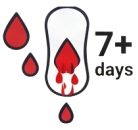
Bleeding that lasts seven days or more leaves a smaller gap before the fertile window opens.

Irregular cycles
When ovulation timing varies, you cannot be sure when your fertile days begin.
Bleeding that is not a period
Spotting around ovulation, implantation bleeding or breakthrough bleeding from hormonal contraception can look like a light period. Sex during that bleeding may actually fall in a fertile time. If you are unsure which of these applies to you, tracking your cycle for a few months usually gives a clear answer.

If You Are Trying to Conceive
Sex during your period will not harm your chances, but it is rarely the best use of your effort. Your chance is highest with intercourse every one to two days in the five days before ovulation and on the day of ovulation. If your periods are short or your cycles vary, ovulation kits and cervical mucus changes help you find those days more reliably than a calendar.
If You Want to Avoid Pregnancy
A period is not a reliable safe time. Cycle-based guesses fail most often in short or irregular cycles, so a contraceptive method used consistently is far more dependable. If you have had unprotected sex and want to prevent pregnancy, emergency contraception works best when taken as soon as possible, and a doctor or pharmacist can advise on options and timing. Condoms also matter during a period, because bleeding does not remove the risk of sexually transmitted infections.
How Candor IVF Center Looks at Unclear Cycles
If your periods are short, very long, unpredictable or hard to tell apart from other bleeding, understanding your pattern is more useful than guessing. At Candor IVF Center, the evaluation begins with your cycle history and the nature of your bleeding. Your doctor then chooses tests according to your needs. An ultrasound can check the uterus and ovaries, a follicular study can show when you actually ovulate, and hormone tests can explain irregular timing. Not everyone needs all of these, and some women need only a consultation and a simple tracking plan.
FAQ
Can I get pregnant on the first day of my period?
The chance is very low, since ovulation is usually still far off.
Can I get pregnant on the last day of my period?
Yes, particularly with a short cycle, because sperm can survive for up to five days.
Does period blood wash sperm away?
No. Menstrual flow does not stop sperm from travelling, so a period gives no protection against pregnancy.
Could light bleeding be implantation bleeding instead of a period?
Yes. It is usually lighter and shorter than a period and appears around the time one is due. A pregnancy test gives a clearer answer.
Is sex during a period safe?
Generally yes, if both partners are comfortable. Protection against infection still matters.Generally yes, if both partners are comfortable. Protection against infection still matters.
When should I see a fertility specialist?
After 12 months of trying if you are under 35, after 6 months if you are 35 or older, or sooner if your periods are irregular or absent.
Putting It in Perspective
Pregnancy during a period is uncommon, yet it is possible, and that small gap is why timing advice works best when it is personal. Knowing your own cycle length, how long you bleed and when you ovulate matters more than any general rule. If those answers still feel unclear, a conversation with a fertility specialist, such as the doctors at Candor IVF Center, can help you read your pattern with confidence.

Dr. Jaydev Dhameliya is an IVF consultant and reproductive medicine specialist with over 17 years of clinical experience helping couples on their journey to parenthood. He holds an MBBS and DGO, and is a Fellow in Minimal Access Surgery (FMAS), a trained laparoscopic surgeon. As Founder and Director of Candor IVF, he specialises in IVF, infertility treatment, laparoscopic gynaecological surgery, and high-risk pregnancy management. Every article he authors or reviews reflects current medical evidence and his hands-on patient experience.