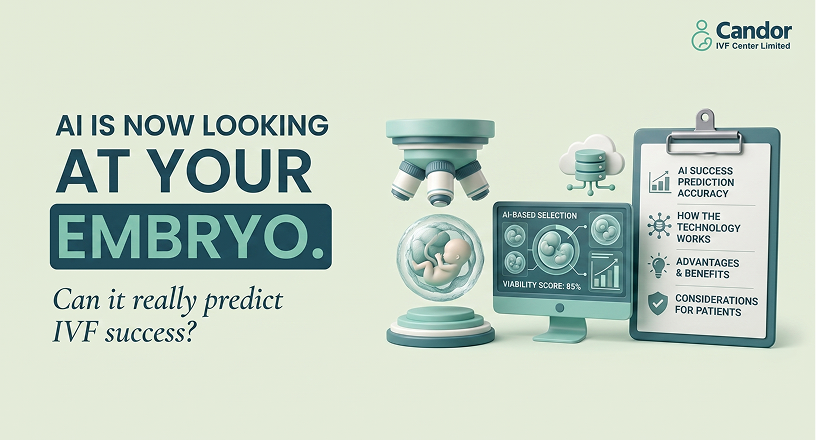


AI Is Now Looking at Your Embryo. Can It Really Predict IVF Success?

AI Is Now Looking at Your Embryo. Can It Really Predict IVF Success

Dr. Jaydev Dhameliya

August 27, 2026

Last Updated – August 27, 2026

Medically reviewed and authored by Dr. Jaydev Dhameliya.

Your Embryologist Is No Longer the Only One Looking at the Screen.

For years, choosing which embryo to transfer came down to one person looking through a microscope, judging shape, cell count, and symmetry in seconds.

That is changing. AI models now score embryos the same way, and in some cases catch patterns the human eye cannot. The real question is not whether AI is involved. It is whether AI actually improves the odds, or whether it is just a good marketing line.

At Candor IVF Center, this is not a future feature. It is already part of how our embryology lab selects embryos today.

Embryos are placed inside a time-lapse incubator fitted with a built-in camera that captures images every 5 to 20 minutes, without ever removing the embryo to check on it. This continuous footage tracks cell division timing, symmetry, fragmentation, and the exact moment an embryo reaches the blastocyst stage.

An AI model trained on thousands of past embryo outcomes analyses this footage and assigns each embryo a viability score. Higher-scoring embryos are prioritised for transfer, since the model has learned which developmental patterns are most linked to implantation and live birth.

This is not a replacement for the embryologist. It is a second, data-driven opinion layered on top of expert judgment.

How Accurate Is AI at Predicting IVF Success?

This is where the honest answer matters more than the hype.

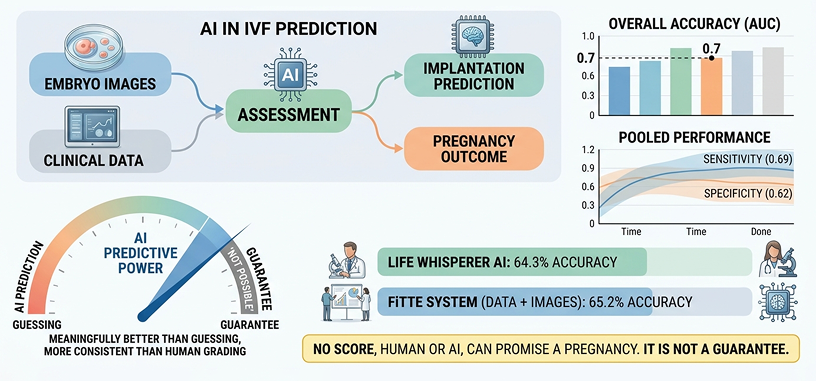
A 2025 systematic review and meta-analysis of AI-based embryo assessment tools found a pooled sensitivity of 0.69 and specificity of 0.62 in predicting implantation success, with an overall accuracy measure (AUC) of 0.7. Individual models varied: the Life Whisperer AI system reached 64.3% accuracy predicting clinical pregnancy, while the FiTTE system, which combines embryo images with clinical data, reached 65.2%.

In plain terms, AI is meaningfully better than guessing, and more consistent than human grading, which can vary between embryologists and even between two assessments by the same person. But it is not a guarantee. No score, human or AI-generated, can promise a pregnancy.

How Accurate Is AI at Predicting IVF Success

AI vs Traditional Embryologist Grading

Treatment depends entirely on the cause, and our reproductive medicine specialists build the plan around your specific diagnosis rather than a standard template.

Consistency

Consistency

AI applies the same criteria to every embryo, every time, removing the natural variation between embryologists or even between two sessions by the same one.

Speed at scale

AI can process every embryo in a batch within seconds, useful in cycles with multiple embryos to rank.

Pattern recognition

Time-lapse AI picks up subtle timing patterns in cell division that are hard to track manually across hundreds of images.

Where human judgment still leads

Where human judgment still leads

Context. An experienced embryologist factors in a couple's history and prior cycle outcomes that a scoring model was never trained to weigh.

What AI Cannot Do

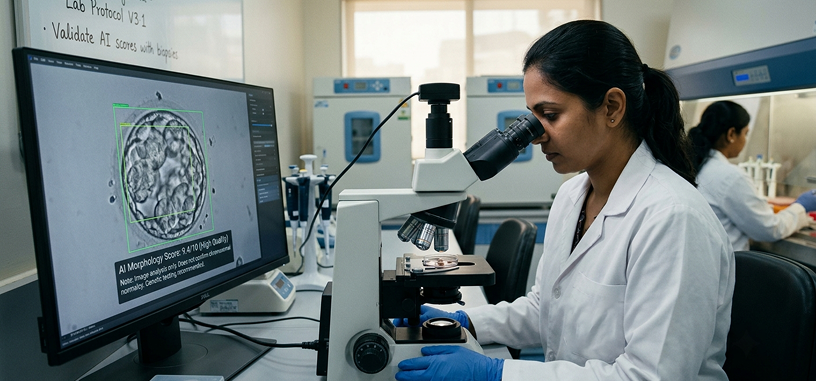
AI does not test for chromosomal normalcy. A high-scoring embryo can still carry a genetic abnormality invisible to image-based scoring, which is why AI is used alongside, not instead of, genetic testing in specific cases.

AI models are also trained on specific populations and lab conditions. A model performing well in one fertility centre can show reduced accuracy at a different centre with a different patient profile or culture protocol. The AI tool itself matters less than the embryology team validating and applying it correctly.

AI in Embryo Selection at Candor IVF

Our embryology lab uses advanced time-lapse incubators paired with AI-assisted embryo selection, alongside Magnetic-Activated Cell Sorting where indicated, to give every embryo an evaluated, undisturbed environment to grow in. The AI score never replaces our embryologists’ final call. It sharpens it, giving our team an additional, objective data point before deciding which embryo gives your cycle the best chance.

FAQ

Does Candor IVF use AI for embryo selection?

Yes. Our embryology lab uses time-lapse incubators with AI-assisted scoring alongside expert embryologist grading for every cycle.

Does AI replace the embryologist at Candor IVF?

No. AI scoring supports the assessment. The final embryo selection decision is always made by our clinical team.

Can AI guarantee my embryo will result in a pregnancy?

No technology can guarantee this. AI improves the odds of selecting the strongest embryo, but implantation depends on several biological factors.

Does AI embryo selection cost extra at Candor IVF?

It is part of our standard embryology process using time-lapse incubation. Any additional testing, like genetic screening, is costed separately, in writing, before you begin.

Is AI embryo selection invasive for the embryo?

No. Time-lapse imaging happens inside the incubator without removing or disturbing the embryo, unlike traditional manual checks.

Should I ask about AI-scored embryo selection during my IVF cycle?

Worth asking your specialist directly. At Candor IVF, this is already built into how we run every embryology cycle.

The Technology Helps. It Does Not Replace the Decision.

AI has genuinely improved how consistently embryos are assessed, and at Candor IVF Center, it is already part of the lab process behind every transfer decision. But the honest picture is that AI adds precision to human expertise, it does not substitute for it. The right question is never AI versus embryologist. It is whether your clinic uses both well.

Book an embryology consultation at Candor IVF Center today.

Blogs