

If your periods have stopped, or have not started yet, it is natural to wonder whether your body is still releasing eggs. The answer is yes, it can. Ovulation and periods are closely linked, but they are not the same event, and understanding how they connect can ease a lot of worry.
Table of Contents
ToggleHow Ovulation and Bleeding Are Connected
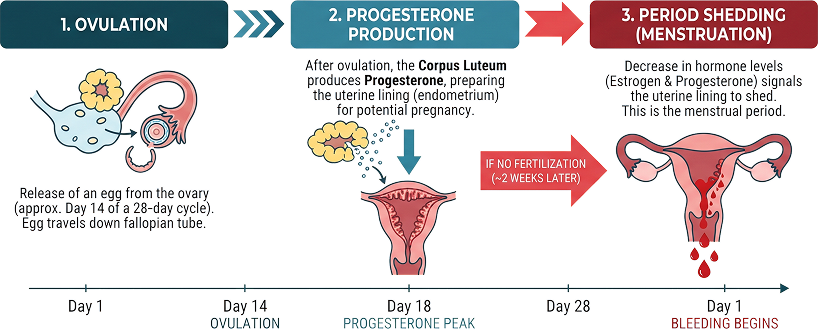
After ovulation, your body produces progesterone to prepare the uterine lining for a possible pregnancy. If no pregnancy occurs, progesterone levels fall, the lining sheds and your period begins. So in most cycles ovulation comes first and the period follows about two weeks later. Because the period depends on ovulation, women often assume that no period means no ovulation. That assumption is not always correct.
When You Can Ovulate Without a Period
After childbirth or while breastfeeding
Ovulation can return before your first period, which means pregnancy is possible even if you have not bled since delivery.
After stopping hormonal contraception
Some women ovulate in the first cycle after stopping, before any bleeding appears.

Early in the teenage years
Cycles take time to settle, and ovulation may begin around the time of the first period or before it.
With a hormonal IUD or similar methods
Periods may become very light or stop altogether, while ovulation continues in many women.
With a blockage or scarring
If the lining cannot drain normally because of scarring inside the uterus or a blocked outflow, ovulation can occur but no blood is visible.

Bleeding Without Ovulation
The reverse can also happen. A cycle in which no egg is released is called an anovulatory cycle, and it can still produce bleeding that looks like a period. This is common in the teenage years and in the years before menopause, and it also occurs with PCOS, thyroid problems and high stress. The bleeding may arrive late, early or in an unusual amount. A visible period therefore does not prove that ovulation took place.
Why Missing Periods Deserve Attention
If your period is late or absent, the first step is a home pregnancy test. If it is negative, there are several common and often treatable explanations:
PCOS, thyroid disorders and raised prolactin can all interrupt ovulation.
Significant stress, rapid weight loss, low body weight or very intense exercise can disrupt the brain signals that trigger ovulation.
Reduced ovarian function can cause periods to become irregular or stop earlier than expected.
Going without a period for three months or more, when your cycles were previously regular, is a good reason to see a doctor. If you are trying to conceive, it is reasonable to ask sooner.
How Candor IVF Center Checks for Ovulation
When periods are absent or unpredictable, symptoms alone cannot say whether you are ovulating. At Candor IVF Center, the evaluation begins with your history: your cycle pattern, any recent changes in weight, stress or medication, and any earlier pregnancies. Your doctor then selects tests according to your situation. A pregnancy test and an ultrasound of the uterus and ovaries are common first steps, and blood tests for hormones such as thyroid, prolactin or progesterone may be added to find the cause. Follicular tracking can show directly whether eggs are developing and being released. Not everyone needs every test, and the findings guide what comes next.
FAQ
Can I get pregnant if I do not get periods?
Only if you ovulate. Absent periods often mean ovulation is infrequent or missing, so a medical review is worthwhile.
Can I conceive after childbirth before my first period returns?
Yes. Ovulation can come back before the first period, so contraception matters if you wish to avoid pregnancy.
Does having a period always mean I ovulated?
No. Anovulatory cycles can still cause bleeding that looks like a normal period.
Can ovulation kits help if I have no periods?
They can offer clues, but results may be misleading in conditions like PCOS, so confirm with your doctor.
Can stress stop ovulation?
Yes. Significant stress, weight loss or intense exercise can disrupt the hormone signals that trigger ovulation.
How long can I wait before seeing a doctor?
If your periods were previously regular, three months without one is a good point to seek advice. If you are trying to conceive, you can ask sooner.
What Your Cycle Is Telling You
Periods and ovulation are partners, not twins. A regular-looking period does not prove an egg was released, and a missing period does not prove that none was. What matters is the pattern over several months and the reasons behind it. If your cycles are absent or unpredictable, you do not have to interpret the signs alone. A conversation with a fertility specialist, such as the doctors at Candor IVF Center, can bring clear answers and a plan that suits you.

Dr. Jaydev Dhameliya is an IVF consultant and reproductive medicine specialist with over 17 years of clinical experience helping couples on their journey to parenthood. He holds an MBBS and DGO, and is a Fellow in Minimal Access Surgery (FMAS), a trained laparoscopic surgeon. As Founder and Director of Candor IVF, he specialises in IVF, infertility treatment, laparoscopic gynaecological surgery, and high-risk pregnancy management. Every article he authors or reviews reflects current medical evidence and his hands-on patient experience.