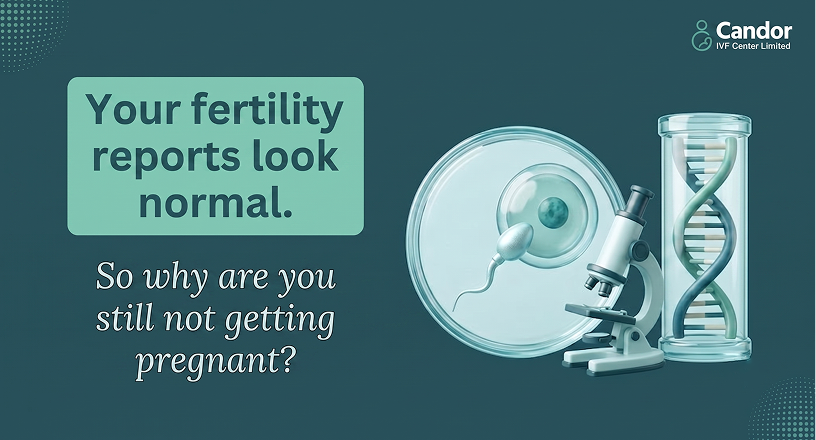


This is one of the hardest conversations in fertility medicine. Every report comes back clean. Ovulation is happening, tubes are open, sperm count is fine, hormones look normal. And yet, month after month, nothing happens. If you’ve heard “everything looks normal” from more than one doctor and still don’t have an answer, you’re not imagining a problem that isn’t there.
Table of Contents
ToggleNormal reports only test what they're designed to test
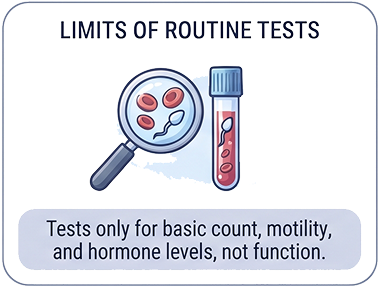
A semen analysis checks count, motility, and shape, not whether that sperm can actually penetrate an egg or carries intact DNA. An AMH test tells you roughly how many eggs you have left, not whether those eggs are genetically capable of forming a healthy embryo. These tests were never built to answer what couples actually care about: whether fertilization and implantation can happen successfully.
Fertilization itself can be the missing piece
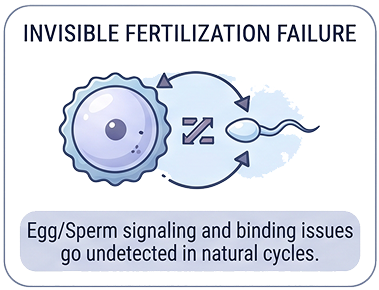
An egg and sperm meeting is not automatic, even when both look normal individually. The egg has to release the right signals, the sperm has to respond correctly, and the two have to bind and fuse in a precise sequence. In a natural cycle, if that step fails, nobody ever finds out. It just looks like another cycle that didn’t work, with no explanation attached.
Egg and sperm quality don't always show up in testing
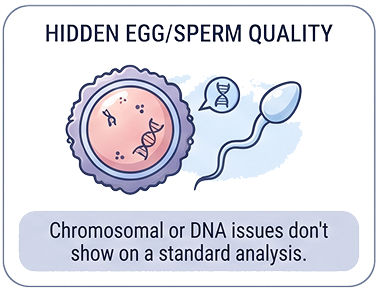
Quantity and quality are different things. A woman can have a reasonable ovarian reserve and still release eggs with chromosomal abnormalities, especially closer to her late thirties. Sperm can look normal under a microscope while carrying DNA fragmentation that basic analysis isn’t designed to catch. Neither shows up as a red flag on paper.
Implantation can fail silently too
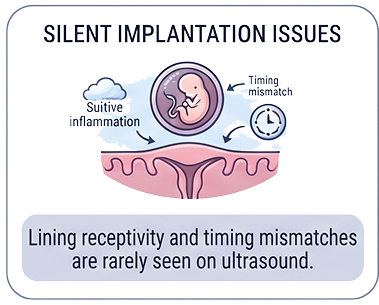
Even a good embryo needs a uterine lining that’s ready to receive it at exactly the right moment. Subtle issues here, mild inflammation, timing mismatches, receptivity problems, rarely show up on a standard ultrasound. They tend to reveal themselves only through repeated failed attempts, which is exhausting and often gets mislabeled as “unexplained.”
Age keeps working against you regardless of what the reports say
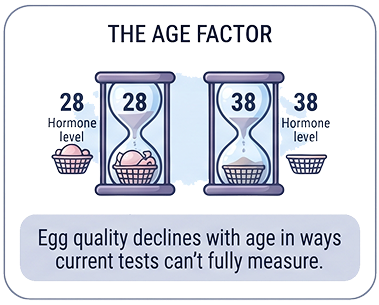
Fertility declines with age in ways that don’t always show up as an abnormal report. A 38 year old and a 28 year old can have identical hormone panels and very different real-world chances of conceiving, simply because egg quality changes over time in ways current testing can’t fully measure.
Why IVF changes the equation
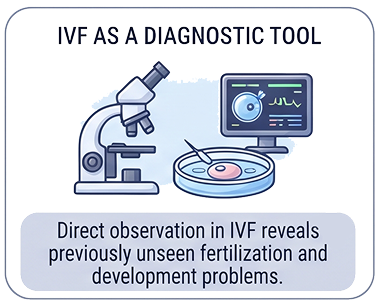
This is where IVF stops being a last resort and becomes a diagnostic tool in its own right. In a natural cycle, fertilization happens somewhere inside the body where nobody can observe it. In IVF, it happens in a lab, under direct observation. If eggs and sperm aren’t fertilizing normally, embryologists see it immediately and can switch to ICSI. If embryos stop developing at a certain stage, that becomes visible information instead of an unexplained failed month, giving problems that were never caught before a real chance to be identified and worked around.
How Candor IVF Center Approaches These Cases
Candor IVF Center has been treating fertility cases across Gujarat since 2009, 17 years of experience across 14+ centers, including four in Surat. For couples with unexplained infertility, the embryology lab uses time-lapse incubators alongside AI-assisted embryo selection, tracking development continuously instead of checking once a day. Every protocol is built around the couple’s specific history rather than a standard package, pricing is shared upfront in writing, and No Cost EMI is available for families who need it. With a 4.9 Google rating from over 9000 families, the clinic has seen this exact situation many times before, and knows how to get to the bottom of it.
Conclusion
Being told your reports are normal shouldn’t mean the search for answers stops there. Fertility involves dozens of small, precise steps, and standard testing isn’t built to catch every one of them. IVF gives doctors direct visibility into the parts of conception that normally happen unseen, turning months of unexplained disappointment into information that can actually be acted on. If this sounds familiar, a proper evaluation with a fertility specialist is worth far more than another round of “everything looks fine.”
FAQ
Can Candor IVF Center help if all our reports are normal?
Yes, unexplained infertility is one of the most common reasons couples consult Candor IVF Center, and a detailed evaluation often uncovers factors standard testing missed.
Does Candor IVF Center offer a free consultation for unexplained infertility?
Yes, a free fertility consultation is available to review your reports and history before recommending any treatment.
How does the embryology lab catch issues that regular tests miss?
Time-lapse incubators and AI-assisted embryo selection let embryologists observe fertilization and embryo development continuously, revealing problems a natural cycle would never show.
Will we need ICSI even if our sperm report is normal?
Not always, but if fertilization doesn’t occur naturally during the IVF process, embryologists can switch to ICSI in the same cycle to directly assist fertilization.
Is IVF the first recommendation for unexplained infertility?
No, doctors typically start with a thorough evaluation and may suggest IUI first in select cases, moving to IVF when it offers a clearer path to answers.
Does Candor IVF Center provide EMI for unexplained infertility treatment?
Yes, No Cost EMI is available so cost isn’t a barrier to getting a proper diagnostic and treatment plan.
How experienced is Candor IVF Center with complex or unexplained cases?
The clinic has been active since 2009, has treated thousands of couples across Gujarat, and holds a 4.9 Google rating from over 9000 families.

Dr. Jaydev Dhameliya is an IVF consultant and reproductive medicine specialist with over 17 years of clinical experience helping couples on their journey to parenthood. He holds an MBBS and DGO, and is a Fellow in Minimal Access Surgery (FMAS), a trained laparoscopic surgeon. As Founder and Director of Candor IVF, he specialises in IVF, infertility treatment, laparoscopic gynaecological surgery, and high-risk pregnancy management. Every article he authors or reviews reflects current medical evidence and his hands-on patient experience.