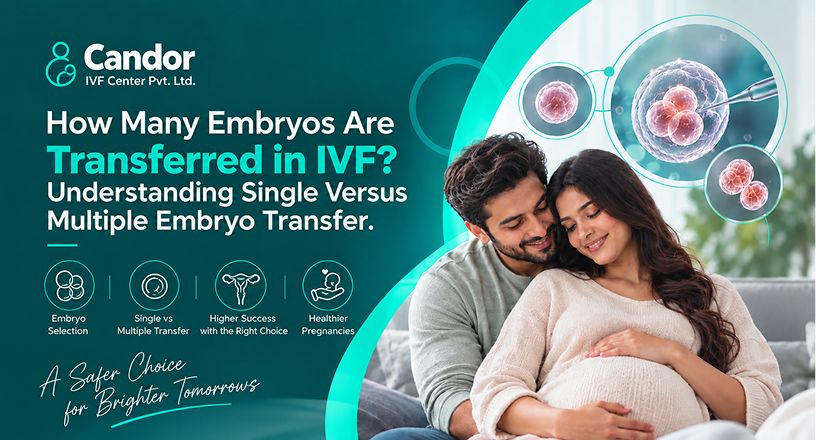


One of the most common questions patients ask at Candor IVF Center, right after the embryology report comes in, is simple: how many embryos will actually be transferred? For years, the assumption among many Indian couples was that transferring more embryos meant a higher chance of pregnancy. Modern fertility medicine has moved away from that thinking, and the decision today depends far more on embryo quality, the patient’s age, and medical history than on sheer numbers.
Table of Contents
ToggleWhat Single Embryo Transfer Means
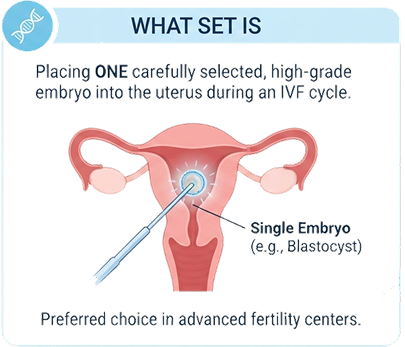
Single Embryo Transfer, often called SET, involves placing one embryo, usually a well-graded blastocyst, into the uterus during an IVF cycle. This approach has become the preferred choice at most advanced fertility centers globally, including Candor IVF Center, especially when the embryo has been cultured to the blastocyst stage and graded highly by the embryology team.
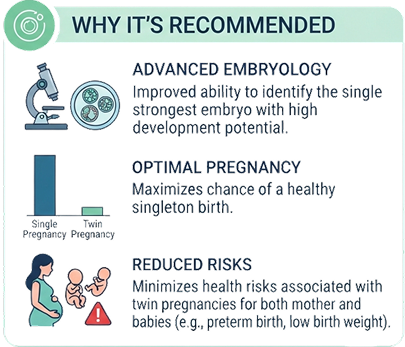
Why doctors increasingly recommend SET: Advances in embryology, including extended blastocyst culture and time-lapse incubation, allow embryologists to identify the strongest embryo with much greater accuracy than was possible a decade ago. When one embryo already shows strong development potential, transferring a second one does not meaningfully raise the chance of pregnancy. It does, however, raise the chance of a twin pregnancy, which carries higher risks for both mother and babies. Many patients are initially hesitant about SET because it feels counterintuitive to hold back a viable embryo, but once the reasoning behind embryo grading is explained, most feel more confident about the decision.
What Multiple Embryo Transfer Means
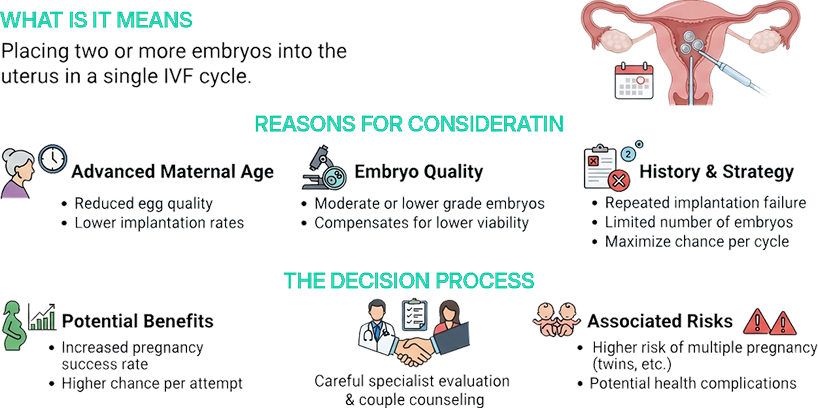
Multiple Embryo Transfer involves placing two or occasionally more embryos into the uterus in a single cycle. This was far more common in the earlier years of IVF, when embryo culture techniques were less refined and it was harder to predict which embryo would implant successfully.
When multiple embryo transfer is still considered: Doctors at Candor IVF Center may recommend transferring more than one embryo in specific situations, such as advanced maternal age, embryos of moderate rather than high grade, a history of repeated implantation failure, or when the couple has a limited number of embryos to work with and wants to maximize the chance of pregnancy within a single attempt. Even in these cases, the decision is never made casually. The specialist weighs the added chance of pregnancy against the added risk of a multiple pregnancy before making a recommendation, and the couple is walked through both sides before the transfer is scheduled.
Why the Number Is Not a One-Size-Fits-All Decision
The right number of embryos to transfer is a clinical decision, not a personal preference, and it is made jointly by the fertility specialist and embryologist after reviewing the full case. Embryo quality and grading play the biggest role, since a top-grade blastocyst has a meaningfully higher implantation potential than a lower-grade one. Age and ovarian reserve matter too, as younger patients with high-quality embryos are usually strong candidates for SET, while older patients or those with prior failed cycles may be counselled differently. Uterine health and previous IVF history also shape the recommendation, particularly for patients who have been through unsuccessful transfers before.
At Candor IVF Center, every patient’s embryology report is reviewed in detail before deciding on the number of embryos, rather than applying a fixed rule to every case. The goal is always a healthy singleton pregnancy wherever medically possible, since twin and multiple pregnancies carry higher risks of premature birth, low birth weight, and complications during delivery.
Conclusion
The number of embryos transferred in an IVF cycle is not about maximizing odds through quantity. It is a carefully weighed medical decision based on embryo quality, the patient’s age, and reproductive history. Single embryo transfer has become the preferred approach at centers with advanced embryology labs because it offers strong success rates while significantly lowering the risks tied to multiple pregnancies. If you are preparing for an embryo transfer and want clarity on what is right for your specific case, a consultation with the specialists at Candor IVF Center can help you understand your embryology report and the reasoning behind the recommended approach.
FAQ
Does Candor IVF Center recommend single or multiple embryo transfer?
The recommendation depends entirely on your embryology report, age, and treatment history. Candor IVF Center’s specialists review each case individually rather than following a standard number for every patient.
Does transferring more embryos always mean a higher chance of pregnancy?
Not necessarily. If the first embryo is a high-grade blastocyst, adding a second embryo mainly increases the chance of a twin pregnancy rather than significantly improving the overall success rate.
Is single embryo transfer safe for first-time IVF patients?
Yes. With Candor IVF Center’s advanced embryology lab and blastocyst grading, many first-time patients with good-quality embryos are strong candidates for single embryo transfer.
Can I request multiple embryo transfer if I prefer it?
Your preference is heard and discussed, but the final recommendation comes from your fertility specialist at Candor IVF Center based on medical safety, since multiple pregnancies carry higher health risks.
What happens to the remaining embryos if only one is transferred?
Any additional good-quality embryos can be cryopreserved at Candor IVF Center for future use, giving you the option of a frozen embryo transfer later without repeating the entire stimulation cycle.
Are twin pregnancies from multiple embryo transfer riskier than single pregnancies?
Yes. Twin pregnancies carry a higher risk of premature delivery, low birth weight, and pregnancy complications, which is a major reason doctors at Candor IVF Center lean toward single embryo transfer whenever the embryo quality supports it.

Dr. Jaydev Dhameliya is an IVF consultant and reproductive medicine specialist with over 17 years of clinical experience helping couples on their journey to parenthood. He holds an MBBS and DGO, and is a Fellow in Minimal Access Surgery (FMAS), a trained laparoscopic surgeon. As Founder and Director of Candor IVF, he specialises in IVF, infertility treatment, laparoscopic gynaecological surgery, and high-risk pregnancy management. Every article he authors or reviews reflects current medical evidence and his hands-on patient experience.