
Can You Get Pregnant While Breastfeeding? What Women Should Know

Dr. Jaydev Dhameliya

November 9, 2026

Last Updated – November 4, 2026

Medically reviewed and authored by Dr. Jaydev Dhameliya.

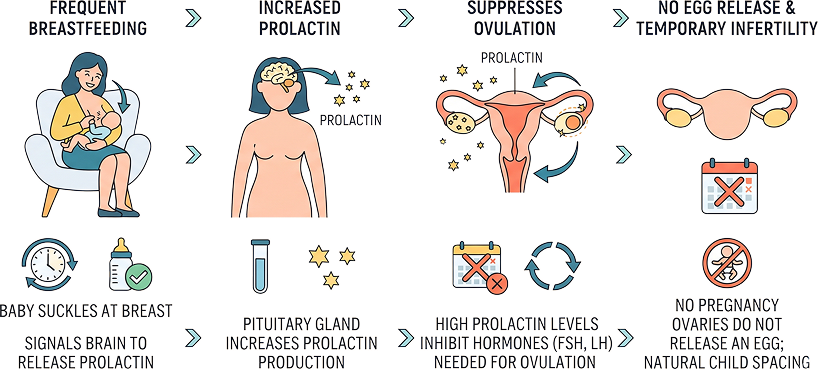
Caring for a newborn leaves little room for guesswork about your fertility, yet new mothers often hear conflicting advice. Some are told breastfeeding prevents pregnancy, while others hear stories of a second baby arriving within months. The clear answer is that pregnancy is possible while breastfeeding, although breastfeeding can delay ovulation under certain conditions.

Why It Is Not a Guarantee

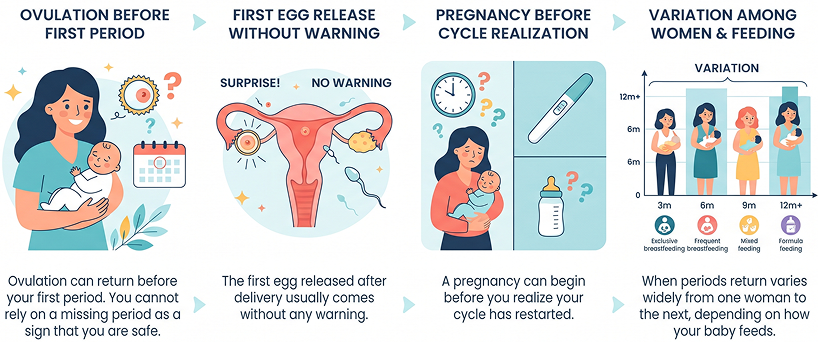
Ovulation can return before your first period, so you cannot rely on a missing period as a sign that you are safe. The first egg released after delivery usually comes without any warning, and a pregnancy can begin before you realise your cycle has restarted. When periods return also varies widely from one woman to the next, depending on how your baby feeds.

When Breastfeeding Offers the Most Protection

The lactational amenorrhea method describes the situation in which breastfeeding is highly effective as natural contraception. All three conditions must be met together:

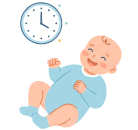
Your baby is under six months old

Protection fades as your baby grows and feeds change.
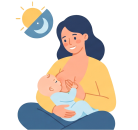
Feeding is full or nearly full

Your baby is nursing day and night, with no regular formula, and without long gaps between feeds.
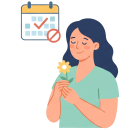
Your period has not returned

The first bleed after delivery signals that fertility may be returning.
If any one of these changes, the protection can no longer be counted on.

What Lowers the Protection

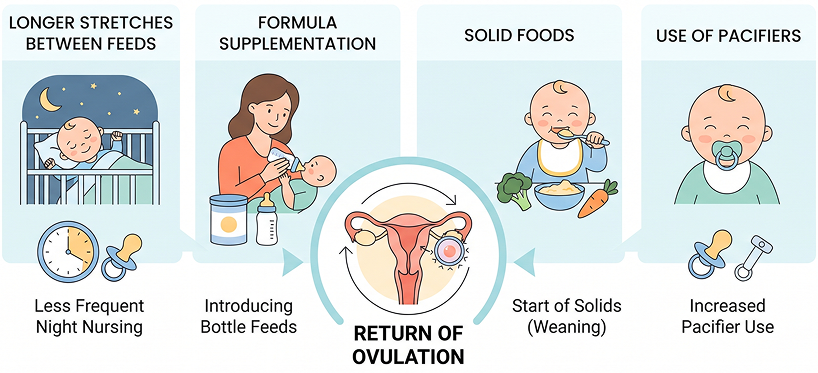
Several everyday changes make ovulation more likely to return. Longer stretches between feeds, such as a baby sleeping through the night, reduce the hormonal effect. Introducing formula, solid foods or a pacifier means less time at the breast. Pumping can also be less reliable than direct nursing, since a baby’s suckling triggers the hormonal response more consistently.

If You Want to Avoid Pregnancy for Now

Many health organisations advise leaving at least 18 to 24 months between a birth and the next conception, which gives your body time to recover. If you are not ready for another pregnancy, a contraceptive method is more dependable than breastfeeding alone. Progestin-only methods, copper IUDs and condoms are generally compatible with breastfeeding, while methods containing estrogen are usually avoided in the early months. Your doctor can recommend the right option for you.

If You Are Hoping for Another Baby

Some women find that conception takes longer while nursing frequently, because ovulation may be irregular or delayed. This is often a matter of time rather than a problem. Weaning is not always necessary, but your doctor can help you judge what suits your situation.

How Candor IVF Center Approaches Planning After Delivery

If you are planning another pregnancy and your cycles have not settled, a doctor-led evaluation can bring clarity. At Candor IVF Center, it begins with your history, including the time since delivery, how your baby feeds and whether your periods have returned. Your doctor then chooses tests according to your situation. An ultrasound of the uterus and ovaries and follicular tracking can show whether you are ovulating, and hormone tests such as prolactin or thyroid may be added if cycles stay irregular. Not everyone needs every test, and some women need only guidance and time.

FAQ

Can I get pregnant before my first period after delivery?

Yes. Ovulation usually returns before the first period, so a pregnancy can begin without any earlier sign.

Yes. Ovulation usually returns before the first period, so a pregnancy can begin without any earlier sign.

Not reliably. Direct nursing stimulates the hormonal response more consistently than pumping does.

Is it safe to keep breastfeeding if I become pregnant?

In a healthy pregnancy it is often possible, but your doctor should advise based on your health and your baby’s needs.

Which contraception suits a breastfeeding mother?

Progestin-only methods, copper IUDs and condoms are generally compatible. Estrogen-containing methods are usually avoided in the early months.

How long should I wait between pregnancies?

Health organisations generally advise at least 18 to 24 months between a birth and the next conception.

Should I take a test if my period is missing while nursing?

Yes, if there is any chance you could be pregnant. Irregular or absent periods are common while nursing, so a test is the clearest answer.

Looking Ahead

Breastfeeding can delay your fertility, but it cannot be counted on to switch it off. Knowing how your own feeding pattern affects your cycle helps you decide what to do next, whether that is waiting a little longer or planning another baby. Whichever you choose, you deserve clear guidance for your own body. A conversation with a fertility specialist, such as the doctors at Candor IVF Center, can help you plan with confidence.

Blogs

Diwali Sweets and Fertility Can Your Festive Diet Affect Hormonal Health

Diwali Sweets and Fertility: Can Your Festive Diet Affect Hormonal Health?

Diwali without mithai is hard to imagine. If you are trying to conceive, though, the sight of a full sweet box can bring a small pang of worry. The reassuring truth is that a few festive treats will not undo your fertility. What matters is your overall eating pattern, and understanding how sugar interacts with your hormones lets you enjoy the festival without second-guessing every bite.

Read More »