



Does Ovarian Reserve Affect IVF? AMH, AFC & What These Tests Actually Tell You

Does Ovarian Reserve Affect IVF AMH, AFC & What These Tests Actually Tell You

Dr. Jaydev Dhameliya

October 1, 2026

Last Updated – October 6, 2026

Medically reviewed and authored by Dr. Jaydev Dhameliya.

Ovarian reserve is one of the first things a fertility specialist checks before recommending an IVF protocol, and it is also one of the most misunderstood terms patients hear at their first consultation. It does not measure whether you can conceive. It measures how many eggs are likely available for a given cycle, which directly shapes how your IVF stimulation is planned.

Every woman is born with a fixed number of eggs, and this number naturally declines with age. Ovarian reserve refers to the remaining quantity of eggs at a given point in time, not their quality. A woman with a lower ovarian reserve can still have healthy, good-quality eggs, and a woman with a higher reserve is not automatically guaranteed better egg quality. This distinction matters because reserve and quality are assessed differently and affect IVF planning in different ways.

What the AMH Test Tells You

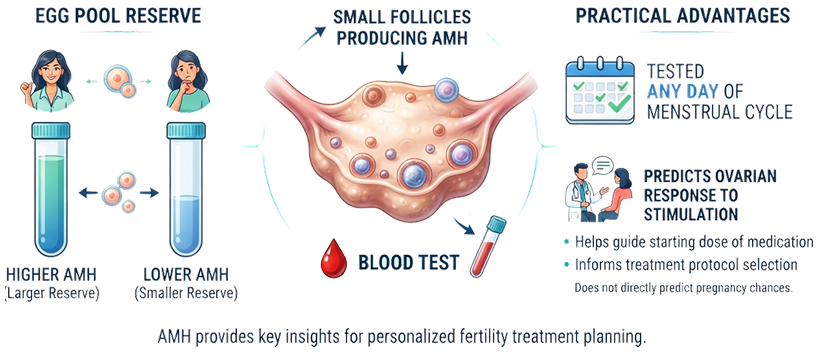
Anti-Mullerian Hormone, or AMH, is a simple blood test that estimates the size of the remaining egg pool. It is produced by the small follicles in the ovaries, so a higher level generally suggests a larger reserve and a lower level suggests a smaller one. One practical advantage of AMH is that it can be tested on any day of the menstrual cycle, unlike several other hormone tests that need to be done on specific days. Doctors use AMH mainly to predict how the ovaries are likely to respond to stimulation medication, helping decide the starting dose and protocol rather than predicting pregnancy chances directly.

What the AMH Test Tells You

What the AFC Test Tells You

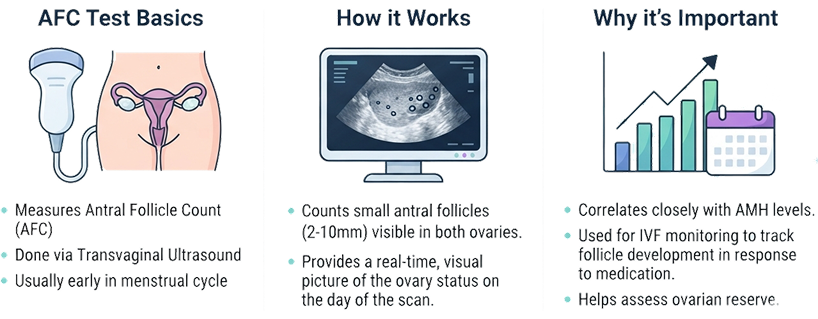
Antral Follicle Count, or AFC, is measured through a transvaginal ultrasound, usually done early in the menstrual cycle. The scan counts the small antral follicles visible in both ovaries at that time, and this count tends to correlate closely with AMH levels. AFC is particularly useful because it gives a real-time, visual picture of the ovaries on the day of the scan, which is why it is often repeated during monitoring visits throughout an IVF cycle to track how follicles are developing in response to medication.

How Candor IVF Center Uses These Tests to Personalize Treatment

At Candor IVF Center, AMH and AFC results are never looked at in isolation. The fertility specialist reviews both alongside the patient’s age, previous cycle history if any, and overall health before finalizing a stimulation protocol. A patient with a lower reserve may be started on a different medication dose or protocol type than one with a higher reserve, since the goal is to retrieve the best possible number of quality eggs without overstimulating the ovaries. This individualized approach, combined with the AI-assisted embryo selection and time-lapse monitoring available at Candor IVF Center’s embryology lab, means that even patients with a lower ovarian reserve are given a realistic, carefully tailored plan rather than a standard protocol applied to everyone.

What Low or High Ovarian Reserve Means for Your IVF Journey

A lower ovarian reserve generally means fewer eggs may be retrieved in a single cycle, which can mean a more tailored medication approach and, in some cases, considering multiple cycles to build up a good number of embryos. It does not mean IVF cannot work. A higher reserve, often seen in younger patients or those with conditions like PCOS, usually means more eggs are retrieved, but it also requires careful monitoring to avoid ovarian hyperstimulation syndrome. Neither extreme is inherently good or bad on its own. What matters is how the specialist adjusts the protocol in response to what these tests reveal.

Conclusion

AMH and AFC are planning tools, not verdicts on your ability to have a baby. They help your fertility specialist understand how your ovaries are likely to respond to stimulation and design a protocol suited to your specific reserve, rather than predicting the outcome on their own. If you are unsure what your reports mean or how they will shape your treatment plan, a detailed consultation at Candor IVF Center can help you understand your numbers in the context of your full fertility picture.

FAQ

Can I get pregnant naturally with low AMH?

Yes, low AMH does not rule out natural conception. It mainly indicates fewer eggs may be available for retrieval in an IVF cycle, not that pregnancy is impossible.

Do AMH and AFC need to be tested on a specific day?

AMH can be tested any day of the cycle. AFC is usually done early in the cycle for the most accurate follicle count.

Does a low ovarian reserve mean IVF will fail?

No. It usually means the protocol is adjusted at Candor IVF Center to suit your reserve, focusing on retrieving the best possible eggs rather than the highest number.

How does Candor IVF Center decide my stimulation dose?

Your AMH, AFC, age, and health history are reviewed together by the specialist to personalize your medication dose and protocol.

Is a high AMH always a good sign?

Not necessarily. It can indicate a good reserve, but very high levels, often linked to PCOS, need careful monitoring to avoid overstimulation.

Should I repeat AMH testing before every IVF cycle?

Not always immediately, since AMH changes gradually. Your Candor IVF Center specialist will advise if retesting is needed based on time elapsed or treatment history.

Blogs