

What Happens If Your IVF Cycle Produces No Eggs? Causes, Next Steps & Treatment Options

What Happens If Your IVF Cycle Produces No Eggs Causes, Next Steps & Treatment Options

Dr. Jaydev Dhameliya

October 12, 2026

Last Updated – October 7, 2026

Medically reviewed and authored by Dr. Jaydev Dhameliya.

You’ve done the injections. You’ve sat through the scans, watched the follicles grow on the monitor, counted down to retrieval day. And then you get the call: no eggs were found. If this has happened to you, or you’re reading this out of fear that it might, know this first: it’s rare, it’s not something you caused, and it doesn’t mean IVF is off the table.

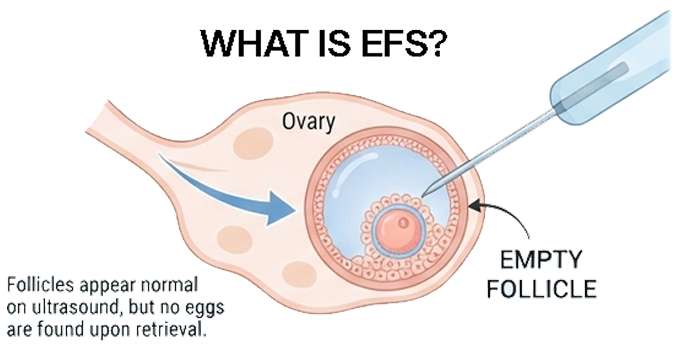
This situation has a name in reproductive medicine: Empty Follicle Syndrome (EFS). It means follicles grew and looked normal on ultrasound, hormone levels appeared fine, but when the embryologist went to retrieve eggs from them, none were there. Studies estimate this happens in under 1% of IVF cycles, so while it feels devastating in the moment, it is genuinely uncommon.

There are two versions of this, and the difference matters a lot for what happens next.

what-is-EFS
False Empty Follicle Syndrome
False Empty Follicle Syndrome is the more common of the two, and the more fixable. It usually comes down to timing. The trigger injection, the shot that tells your eggs to finish maturing before retrieval, has to be given at a precise time, roughly 34 to 36 hours before the procedure. If it's given too late, administered incorrectly, or the retrieval happens too early or too late relative to that window, the eggs may not have detached from the follicle wall yet, or may already have been released. In some cases, the hCG trigger simply doesn't reach a strong enough level in the blood, which can happen with dosing errors or occasionally with a weaker batch of medication.
Genuine Empty Follicle Syndrome
Genuine Empty Follicle Syndrome is rarer and harder to explain. Here, the trigger worked exactly as it should, hormone levels on retrieval day were normal, but eggs still weren't recovered. Researchers now believe this can be linked to how the ovaries respond to stimulation, and in some documented cases, to a genetic factor affecting how the egg develops within the follicle. Diminished ovarian reserve and age can also raise the odds of this happening.

What This Means for You

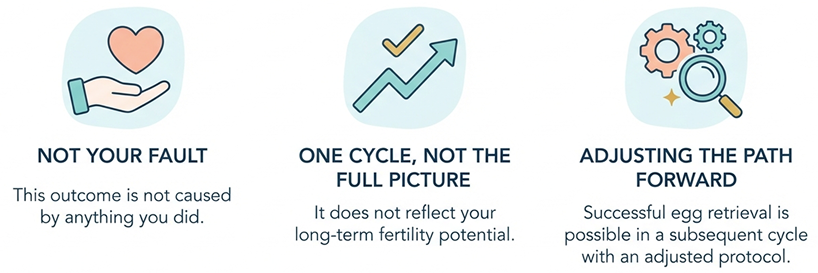
The first thing to understand is that this doesn’t happen because of something you did. It isn’t a reflection of your fertility long-term, and it doesn’t automatically mean your ovaries have “nothing left.” Many women who experience this go on to retrieve eggs successfully in a following cycle, especially once the cause has been identified and the protocol has been adjusted.

What Happens Next

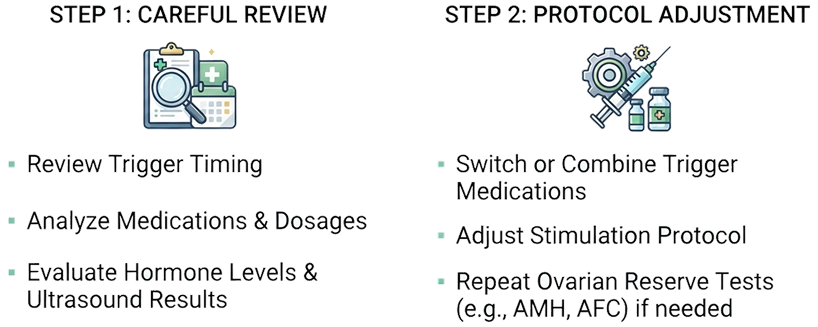
Once a cycle produces no eggs, a good fertility team doesn’t just repeat the same plan and hope for a different result. The next step should always start with a careful review: what was the trigger timing, what medication and dose were used, what were the hormone levels on the day of retrieval, and what did the ultrasound actually show. This review usually points toward whether it was a timing issue or something that needs a different approach altogether.

From there, the protocol is typically changed for the next attempt. This might mean switching the trigger medication, using a dual trigger that combines two drugs to improve the chances of egg maturation, adjusting the exact timing between trigger and retrieval, or changing the stimulation protocol entirely based on how your ovaries responded the first time. In some cases, additional tests like AMH and antral follicle count are repeated to get a clearer picture of ovarian reserve before deciding on the next cycle.

What Happens Next

How Candor IVF Center Approaches This

At Candor IVF Center, every cycle is monitored closely, right down to trigger timing and hormone tracking, precisely to prevent the false form of this condition from happening in the first place. If a patient has had this experience elsewhere, our reproductive medicine specialists review the previous cycle in detail before building the next protocol, rather than starting from scratch with guesswork. With 17 years of experience and an embryology lab built around precision at every step, our goal is to make sure a difficult cycle becomes a lesson the next one learns from, not a dead end.

If this has happened to you, you deserve answers, not just sympathy. Book a consultation with Candor IVF Center to understand exactly what happened and what your next step should look like.

FAQ

Is it common to get zero eggs during IVF retrieval?

No, it’s rare. Empty Follicle Syndrome affects less than 1% of IVF cycles.

Does this mean I have no eggs left or can't get pregnant?

Not at all. Most cases are linked to trigger timing rather than actual egg supply, and many women go on to retrieve eggs successfully in a later cycle.

Can Empty Follicle Syndrome happen again in my next cycle?

It’s possible, but far less likely once the cause is identified and the protocol is adjusted accordingly.

Will I need a different stimulation protocol next time?

Often, yes. Your specialist may change the trigger medication, use a dual trigger, or adjust timing based on what happened in the previous cycle.

How can Candor IVF Center help if this has already happened to me?

Our specialists review your previous cycle details closely, from trigger timing to hormone levels, and build a revised, more targeted protocol for your next attempt.

Blogs