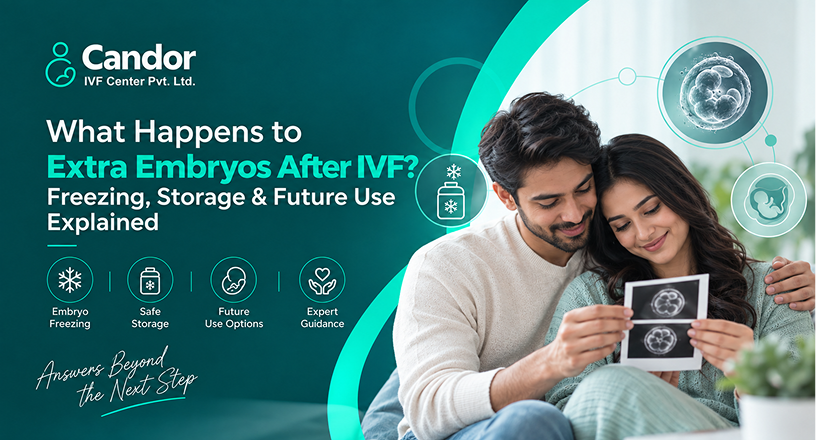
An IVF cycle at Candor IVF Center often produces more than one usable embryo, and once the transfer is done, couples are left with a genuine question: what happens to the rest? This is not a small detail tucked away in a consent form. It shapes future family planning, and understanding it upfront removes a lot of confusion later in the journey.
Table of Contents
ToggleWhy Extra Embryos Exist in the First Place
During stimulation, the ovaries are encouraged to produce multiple eggs rather than the single egg released in a natural cycle. Once fertilized and cultured in the embryology lab, several of these may develop into good-quality embryos, even though only one, or occasionally two, are transferred in that cycle. The remaining embryos are cryopreserved rather than discarded, so one round of injections and egg retrieval can potentially support more than one attempt at pregnancy.
How Embryo Freezing Actually Works
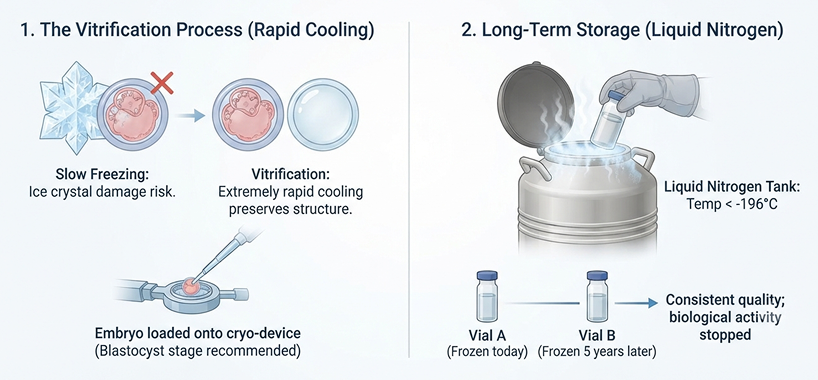
Vitrification is the standard freezing method today. Rather than slow freezing, which carried a higher risk of ice crystal damage to delicate embryo cells, vitrification cools the embryo at an extremely rapid rate, preserving its structure far more reliably. Embryos suitable for freezing are usually those that have reached the blastocyst stage, since these tend to survive the freeze-thaw cycle with the highest consistency.
Storage happens in liquid nitrogen tanks at extremely low temperatures, where biological activity essentially stops. This means an embryo frozen today and one frozen five years from now face no meaningful difference in quality purely due to the passage of time in storage.
How Candor IVF Center's Embryology Lab Handles Freezing and Storage
Candor IVF Center’s embryology lab uses time-lapse incubators and AI-assisted embryo selection to identify which embryos are strong enough to freeze in the first place, rather than freezing every surplus embryo regardless of quality. This matters because a poorly graded embryo has a much lower chance of surviving the thaw process, and being selective at the freezing stage protects the couple from false hope later. With centers across Surat and 14 branches in Gujarat, patients can also plan a future frozen embryo transfer at whichever location suits them, without needing to return to the exact branch where the original cycle was done. No Cost EMI options extend to future FET cycles as well, so the financial planning for a second attempt or a second child does not have to start from zero.
What Couples Can Do With Frozen Embryos
The stimulation injections and blood tests are the part that needs the most coordination, simply because of timing rather than physical strain. Scheduling monitoring visits at a Candor IVF Center branch close to home or office, whether in Kapodra, Vesu, Katargam, or Adajan, cuts down travel time significantly and makes it easier to slot appointments before or after work.
Future frozen embryo transfer (FET): The most common reason couples freeze embryos. If the first transfer does not succeed, or the couple wants a second child later, a frozen embryo can be thawed and transferred without repeating egg retrieval or stimulation injections.
Family planning for a second child: Many couples freeze remaining embryos specifically for a sibling later, avoiding a restart of IVF from scratch.
Extended storage for personal circumstances: Some couples pause treatment for medical, financial, or personal reasons and simply keep embryos in storage until ready to continue, without pressure to decide immediately.
What Indian Law Says About Storage and Embryo Fate
Under the Assisted Reproductive Technology (Regulation) Act, 2021, embryos can be stored for a maximum of 10 years, after which the couple must decide whether they are allowed to perish or donated to a registered research institution with consent. Embryos remain legally tied to the couple that created them, and clinics must obtain clear, written consent covering their fate in situations like separation or death of either partner. Candor IVF Center walks every couple through this documentation before freezing begins, so there is no ambiguity later.
Conclusion
Extra embryos after an IVF cycle are a genuine asset for family planning, not a leftover to worry about. Reliable freezing technology, careful embryo selection, and clear legal safeguards make it possible to plan a future FET or a second child without starting over. If you have embryos in storage or are about to begin a cycle, the team at Candor IVF Center can walk you through what freezing involves and what the paperwork means for your specific situation.
FAQ
Does Candor IVF Center freeze embryos for all patients?
Only good-quality surplus embryos are recommended for freezing, based on assessment by the embryology team using time-lapse and AI-assisted grading.
How long can embryos stay frozen before being used?
Up to 10 years under Indian law. Candor IVF Center maintains detailed consent records so couples always know their timeline.
Does a frozen embryo transfer require another full IVF cycle?
No. It skips egg retrieval and stimulation injections entirely; the embryo is simply thawed and transferred.
Are frozen embryos less likely to result in pregnancy than fresh ones?
Not significantly. With vitrification and careful embryo selection, success rates are often comparable to fresh transfers.
Can I decide what happens to my embryos if I no longer wish to use them?
Yes, through consent forms signed at the time of freezing, in line with what Indian law permits.
What if my partner and I disagree about using the frozen embryos later?
Since embryos legally belong to both partners jointly, both must consent to their use, which is why Candor IVF Center documents each partner’s wishes clearly from the start.
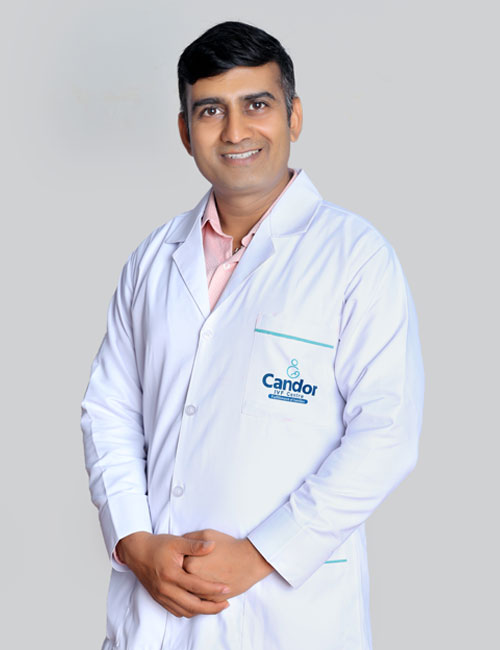
Dr. Jaydev Dhameliya is an IVF consultant and reproductive medicine specialist with over 17 years of clinical experience helping couples on their journey to parenthood. He holds an MBBS and DGO, and is a Fellow in Minimal Access Surgery (FMAS), a trained laparoscopic surgeon. As Founder and Director of Candor IVF, he specialises in IVF, infertility treatment, laparoscopic gynaecological surgery, and high-risk pregnancy management. Every article he authors or reviews reflects current medical evidence and his hands-on patient experience.