

An IVF patient at Candor still remembers what her gynecologist told her during a routine checkup in Surat. “Your cycle is textbook. Twenty-eight days, on time, every month.” She felt relieved, because for years she had assumed a regular period meant everything downstairs was working fine. Eleven months later, she was still not pregnant, and that “textbook” cycle suddenly felt like it was hiding more than it was telling her.
If this sounds familiar, you are not alone. Many couples walking into Candor IVF Center say the exact same thing. “My periods are perfectly regular, so why isn’t this happening?” Here is the truth nobody tells you early enough: a normal period only confirms that ovulation is probably happening. It does not confirm that your eggs, tubes, uterus, or your partner’s sperm are ready for conception. Fertility depends on several working parts, and a regular cycle is just one of them.
Here are 7 fertility problems that often hide behind a completely normal period.
Table of Contents
Toggle1. Unexplained Infertility
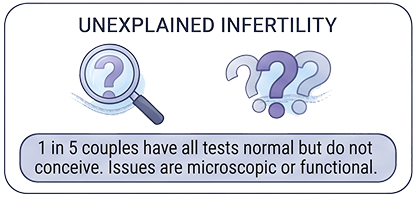
Around 1 in 5 couples get every test back normal and still do not conceive. This does not mean nothing is wrong, it usually means the problem lies at a level routine tests cannot catch, like egg quality or fertilization ability.
2. Blocked or Damaged Fallopian Tubes
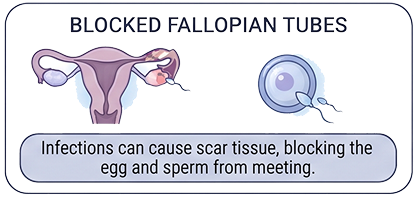
A past infection or silent pelvic inflammatory disease can leave scar tissue that blocks the tubes. Periods stay normal because the ovaries and uterus are unaffected, but if the egg cannot travel to meet the sperm, natural conception cannot happen.
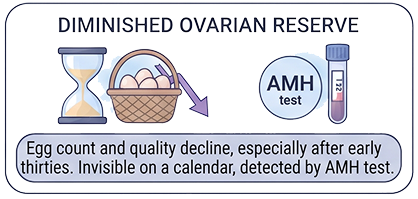
3. Diminished Ovarian Reserve
Your cycle can stay regular for years even as egg count and quality quietly decline, especially after your early thirties. This is a common reason for unexplained struggle, and it usually shows up only on an AMH blood test, not on a calendar.
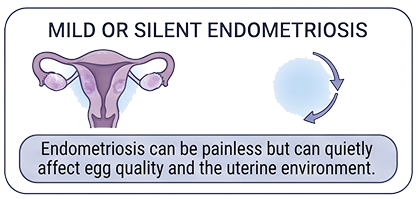
4. Mild or Silent Endometriosis
Endometriosis does not always cause heavy or painful periods. In many women it stays silent, quietly affecting egg quality and the uterine environment, while the monthly cycle looks completely unremarkable.
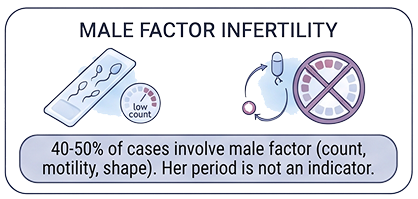
5. Male Factor Infertility
This gets missed constantly because attention naturally goes to the woman’s cycle first. Nearly 40 to 50 percent of infertility cases involve a male factor, low count, poor motility, or abnormal shape. Her period has nothing to do with it.
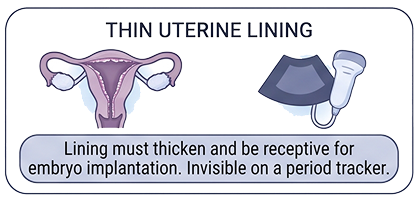
6. Thin or Unreceptive Uterine Lining
Ovulation can happen on schedule, but if the lining does not thicken properly or become receptive at the right window, an embryo cannot implant. This stays invisible on a period tracker and needs proper ultrasound evaluation.
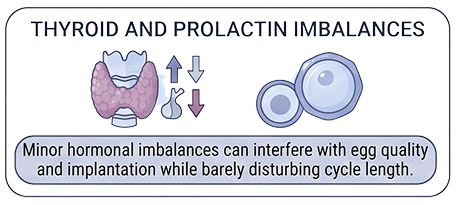
7. Thyroid and Prolactin Imbalances
Subclinical thyroid issues or slightly elevated prolactin can interfere with egg quality and implantation while barely disturbing cycle length. These are usually caught only with a fertility-focused hormone panel, not a routine one.
The Real Takeaway
A normal period is reassuring, but it is not a fertility clearance certificate. If you have been trying for over a year (or over 6 months if you are 35 or above) with no luck despite regular cycles, the next right step is a proper fertility evaluation, not more waiting. At Candor IVF Center in Surat, our specialists look beyond the calendar, checking egg reserve, tubal health, uterine receptivity, and male fertility together, so you get real answers instead of more guesswork. With 17 years of experience, 14+ centers across Gujarat, and transparent, EMI-friendly pricing, getting clarity does not have to mean more delay.
If your periods are normal but your patience is running out, book a free consultation with Candor IVF Center today.
FAQ
I have regular periods, do I still need a fertility test?
Yes. Regular periods only suggest ovulation, not egg quality, tubal health, or uterine readiness. A basic fertility panel gives the full picture.
How soon should I visit Candor IVF if I am not conceiving?
After 12 months of trying if you are under 35, or 6 months if you are 35 or above. Earlier if you have PCOS, endometriosis, or irregular cycles.
Does Candor IVF Center test both partners?
Yes. Every evaluation at Candor IVF includes both partners, since nearly half of infertility cases involve a male factor.
What tests will Candor IVF recommend first?
Typically an AMH test, ultrasound for ovarian reserve and uterine lining, tubal patency check, hormone panel, and semen analysis for the male partner.
Is IVF the only option if my period is normal but I'm not conceiving?
No. Depending on diagnosis, Candor IVF may recommend IUI, medication, or minor surgery before IVF is even considered.
Does Candor IVF Center offer EMI options for fertility treatment?
Yes, No Cost EMI is available so cost isn’t a barrier to getting a proper diagnostic and treatment plan.
How experienced is Candor IVF Center with complex or unexplained cases?
Yes, Candor IVF offers transparent pricing with No Cost EMI, so cost does not delay your diagnosis or treatment.

Dr. Jaydev Dhameliya is an IVF consultant and reproductive medicine specialist with over 17 years of clinical experience helping couples on their journey to parenthood. He holds an MBBS and DGO, and is a Fellow in Minimal Access Surgery (FMAS), a trained laparoscopic surgeon. As Founder and Director of Candor IVF, he specialises in IVF, infertility treatment, laparoscopic gynaecological surgery, and high-risk pregnancy management. Every article he authors or reviews reflects current medical evidence and his hands-on patient experience.