
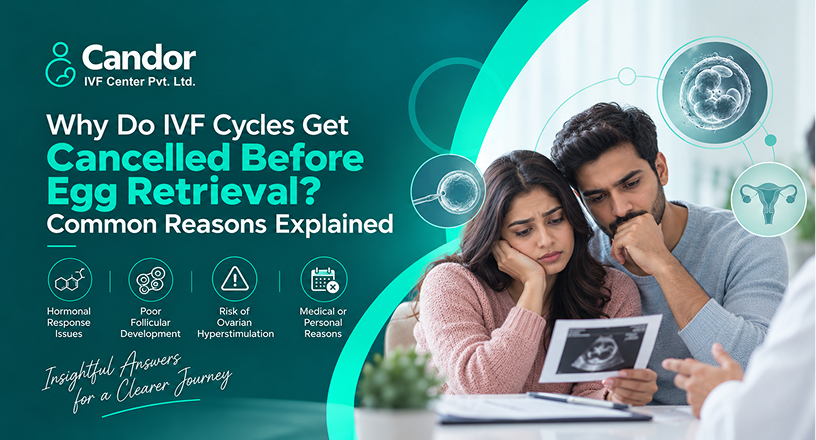


Hearing that an IVF cycle may need to be cancelled before egg retrieval is unsettling, especially after days of injections and monitoring visits. It happens more often than most patients expect, and in nearly every case, it is a protective decision rather than a failure of the treatment. Here is what actually leads to a cancellation, and why it is usually a course correction rather than a setback.
Table of Contents
ToggleThe Most Common Reasons a Cycle Gets Paused

Poor ovarian response.
Monitoring scans track how many follicles are growing and at what pace. If very few develop despite an adequate medication dose, retrieval would likely yield too few usable eggs, so the specialist may cancel and adjust the protocol, sometimes changing the medication type or dose, for the next attempt.

Risk of Ovarian Hyperstimulation Syndrome (OHSS).
The opposite can happen too. If the ovaries respond too strongly, with an unusually large number of follicles and rapidly rising estradiol, OHSS risk climbs. This can range from mild bloating to a more serious condition needing hospitalization. Doctors may cancel the fresh transfer, freeze all resulting embryos for later, or pause the cycle entirely to protect the patient's health.
Premature ovulation or an LH surge.
Occasionally the body triggers ovulation on its own before the scheduled retrieval, despite medication meant to prevent this. If detected during monitoring, the eggs may release too early to retrieve, making the cycle unviable as planned.

Hormone levels that do not track as expected.
Estradiol is checked closely because it reflects how follicles are maturing. Levels that rise too slowly, plateau, or drop unexpectedly can signal the eggs are not developing well, even if follicle count on ultrasound looks reasonable.
Cysts, illness, or personal circumstances.
A baseline scan can reveal a cyst that needs to resolve first, or an unexpected health issue or personal situation can call for a pause. These are less about the ovaries and more about ensuring the right conditions before retrieval.

How Candor IVF Center Handles These Situations
Every stimulation cycle at Candor IVF Center is tracked through frequent ultrasound scans and hormone blood tests, so patterns like poor response or overstimulation risk are caught early rather than discovered only at the point of retrieval. When a cancellation does become necessary, the specialist reviews the monitoring data with the couple in detail, explaining exactly what happened and how the next protocol will be adjusted, whether through a different medication dose, a different stimulation approach, or additional tests before restarting. This transparent, doctor-led review is why most patients who face one cancelled cycle go on to a successful retrieval in their next attempt.
Conclusion
A cancelled IVF cycle before egg retrieval is rarely the end of the road. It is usually a safety call made because the ovaries responded too little or too much, timing shifted unexpectedly, or health circumstances required a pause. Close monitoring exists precisely to catch these situations early and adjust course before retrieval. If you have experienced a cancelled cycle or want to understand your monitoring reports better, the specialists at Candor IVF Center can walk you through what happened and how your next protocol will be planned.
FAQ
Does a cancelled cycle mean IVF will not work for me?
No. Most patients who have one cycle cancelled go on to a successful retrieval once the protocol is adjusted.
How does Candor IVF Center decide when to cancel a cycle?
The decision rests on ultrasound follicle tracking and hormone blood tests reviewed by your specialist, never a single reading alone.
Will I lose my medication cost if a cycle is cancelled?
This varies by case and the stage at which cancellation happens. Candor IVF Center discusses cost implications with you transparently as part of the review.
Can OHSS risk be managed without cancelling the cycle entirely?
Sometimes. Doctors may freeze all embryos for a later transfer instead of a fresh one, protecting your health without a full cancellation.
How soon can I start a new cycle after a cancellation?
This depends on the reason for cancellation and your recovery. Your Candor IVF Center specialist will advise a suitable timeline at your follow-up.
Does frequent monitoring reduce the chance of a cancelled cycle?
Yes. Close, regular monitoring helps catch poor response, overstimulation, or hormone mismatches early, often allowing timely adjustments before cancellation is needed.

Dr. Jaydev Dhameliya is an IVF consultant and reproductive medicine specialist with over 17 years of clinical experience helping couples on their journey to parenthood. He holds an MBBS and DGO, and is a Fellow in Minimal Access Surgery (FMAS), a trained laparoscopic surgeon. As Founder and Director of Candor IVF, he specialises in IVF, infertility treatment, laparoscopic gynaecological surgery, and high-risk pregnancy management. Every article he authors or reviews reflects current medical evidence and his hands-on patient experience.