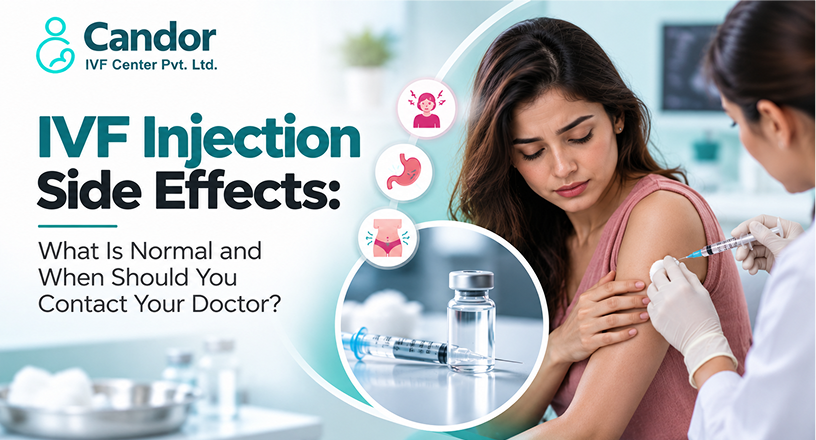


IVF Injection Side Effects: What Is Normal and When Should You Contact Your Doctor?

IVF Injection Side Effects What Is Normal and When Should You Contact Your Doctor

Dr. Jaydev Dhameliya

October 17, 2026

Last Updated – October 7, 2026

Medically reviewed and authored by Dr. Jaydev Dhameliya.

If you’ve just started your IVF injections, or you’re about to, chances are you’ve already looked up every possible side effect at 2 a.m. That’s normal too. The daily shots are one of the more physically demanding parts of the process, and knowing what to expect, and what genuinely needs a phone call, can take a lot of the anxiety out of it.

IVF stimulation medications work by pushing your ovaries to grow multiple follicles in a single cycle, instead of the one your body would normally release. That means your hormone levels, particularly estrogen, rise much higher and much faster than in a natural cycle. Most of what you’ll feel over the next 8 to 12 days of injections comes directly from that hormonal shift, not from anything going wrong.

What's Normal During Stimulation

These symptoms are common and expected, and they don’t mean your body is reacting badly to treatment:

Poor ovarian response.

Poor ovarian response.

As follicles grow, your ovaries temporarily enlarge, which can make you feel full, tight, or swollen around the lower abdomen. This tends to build gradually through the stimulation phase.
Injection site reactions.

Injection site reactions.

Redness, a small bruise, or mild soreness where the needle went in is common and usually settles within a day. Rotating injection sites and letting the medication reach room temperature before injecting can reduce this.

Mood swings and irritability.

Mood swings and irritability.

The rapid hormonal shifts can affect you emotionally the same way severe PMS might, only more intense. This is hormone-driven, not a reflection of how you're coping.
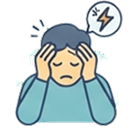
Fatigue, mild headaches, and breast tenderness.

Fatigue, mild headaches, and breast tenderness.

All commonly reported, and all typically resolve once you move past the stimulation phase into retrieval.
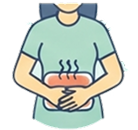
Mild cramping after retrieval.

Mild cramping after retrieval.

Usually eases within 24 to 48 hours.
When You Should Actually Call Your Doctor

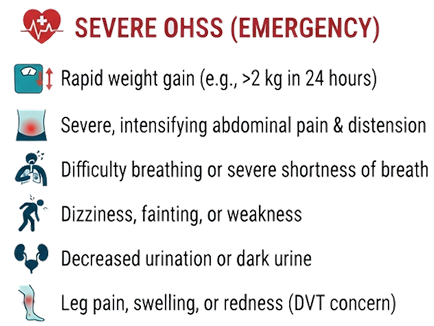
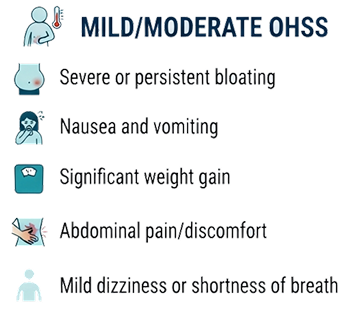
The main thing your care team is watching for during stimulation is Ovarian Hyperstimulation Syndrome, or OHSS. It happens when the ovaries respond more strongly to the medication than expected, causing fluid to shift out of the blood vessels and into the abdomen. Mild versions of this are fairly common, affecting up to roughly one in five stimulated cycles in some form, but moderate to severe OHSS is much rarer, affecting an estimated 1 to 5% of IVF cycles.

severe-OHSS

Call your clinic the same day if you notice:

Rapid weight gain, more than about a kilogram within 24 hours

Abdominal swelling or pain that is steadily getting worse rather than staying the same

Persistent nausea or vomiting

Noticeably reduced urination

Seek emergency or urgent care immediately if you experience:

Shortness of breath or difficulty breathing

Severe or sudden abdominal pain

Signs of dehydration, such as dizziness or very dark, minimal urine

Leg swelling, leg pain, or chest pain, which can point to a blood clot

Fever above 38°C after retrieval or transfer, which can indicate infection

None of these symptoms mean you did anything wrong. They mean your body needs a closer look, and catching them early is exactly what prevents them from becoming serious.

How Candor IVF Center Supports You Through Stimulation

At Candor IVF Center, every stimulation cycle is monitored through regular ultrasounds and hormone level tracking, so your specialist can see early signs of an over-response before it becomes OHSS, and adjust your medication dose accordingly. Our team also walks you through exactly what to expect at each stage of your injections, so you’re never left guessing whether what you’re feeling is routine or something to flag. If you do reach out with a concern, you’re speaking with the same team that has been following your cycle from day one, not starting the conversation from scratch.

If your injections are making you feel something you weren’t warned about, don’t sit with the uncertainty. Reach out to Candor IVF Center, and let your specialist tell you plainly whether it’s normal or needs a closer look.

FAQ

Is bloating during IVF injections something to worry about?

Mild bloating is a normal part of ovarian stimulation and usually builds gradually. It only becomes a concern if it worsens rapidly or comes with pain, nausea, or reduced urination.

How do I know if I'm developing OHSS?

Watch for fast-rising abdominal swelling, rapid weight gain, persistent vomiting, reduced urination, or breathlessness. If any of these appear, contact your clinic the same day.

Are mood swings during IVF injections normal?

Yes. The hormonal changes from stimulation medication can cause irritability and emotional sensitivity similar to intense PMS, and this typically eases once the injection phase ends.

Can injection site soreness mean something is wrong?

Usually not. Mild redness or a small bruise is common and resolves quickly. A hard, spreading lump or swelling that doesn’t improve should be shown to your doctor.

When should I go to the hospital instead of just calling the clinic?

If you have severe abdominal pain, difficulty breathing, signs of a blood clot, or symptoms of severe dehydration, seek emergency care immediately rather than waiting for a callback.

Blogs